Showing posts with label ANZAC. Show all posts

Friday, 1 April 2022

ANZAC 2022: A Lasting Reminder?


Photo by Alison 

Remembering those who fought for New Zealand in the other localised wars across the globe, and those who grew not old.

1899-1902 Anglo-Boer War and following on from World War 2, 1948-1965 
Our first international war was the Boer War of 1899-1902 in the Transvaal region of South Africa. Following the British annexation of Transvaal in October 1900, the conflict in South Africa entered a second phase: guerrilla war.

Rotorua men were recruited and of the men who went, only one did not come home. This soldier was Fred Wylie who was killed in action at Klippersfontein. Wylie was part of the 7th contingent, 8 Coy., he was a farmer who lived at Galatea. His father Mr Joseph Wylie was a teacher and JP.

Others who went from Rotorua are Henry Robert Seymour Corlett, his father was Mr. B.S. Corlett and George Steele, one of the brothers who owned the Sawmill on the corner of Tutanekai and Eruera Sts, was a Sergeant and was shipped out at the same time as Wylie and Corlett. New Zealand soldiers are recorded in Stowers ‘Rough Riders at War’, also recorded is the names of the Maori detachment, two Te Arawa men are named, E. Hikairo and A. Wiari.  Stowers reports that some of the names in the list could be misspelt. 

Maori were not welcomed by the British and were officially excluded from service in South Africa, however Premier Richard Seddon made a push for Maori participation:

although permission to form a Māori contingent was never received, the New Zealand authorities sometimes turned a blind eye to individual Māori who tried to enlist under English names. Most of those who succeeded were ‘half-castes,’ as those of mixed race were then generally known. Many were well-educated and fluent in spoken and written English. NZHistory.govt.nz.

Stowers also mentions the Māori nurses and orderlies who served during 1900, one such orderly was Petera Waaka (Tuhourangi). No further information is mentioned here.
The Wylie Memorial was commissioned and Mr Parkinson of Auckland was appointed, completing the statue by January of 1904, it was unveiled c.19 January 1904. The statue comprised a water fountain at its base and above a representation of the fallen soldier.  Other memorials like this one were also erected elsewhere in NZ.
Price, William Archer, 1866-1948: Collection of post card negatives. Ref: 1/2-001505-G. Alexander Turnbull Library, Wellington, New Zealand. natlib.govt.nz/records/23080236

After World War Two...
JayForce 1946-1948
Outside of the well documented WW1 and WW2, JayForce was formed and served in Japan, as the New Zealand contingent of the British Commonwealth Occupation Force.
Many Rotorua men were sent overseas for World War 2 and some stayed on moving to JayForce and serving there for the following reason: 

The Commonwealth troops were to oversee Japanese demilitarisation and demobilisation. Jayforce was initially deployed in Yamaguchi prefecture on the southern tip of the main island of Honshu, and on nearby Eta Jima Island. This was a relatively poor rural region with a population of 1.4 million – not much less than New Zealand’s total population at the time.  The New Zealanders’ first task was to search for military equipment. Little was found, as Yamaguchi had not had a major military presence during the war. Jayforce also assisted with the repatriation of Japanese who were coming home and Koreans who were being returned to their own country…  An April 1948 decision to withdraw Jayforce from Japan was implemented by early 1949. (NZHistory.govt.nz)

Approximately 45 Rotorua men were part of the BCOF you can find their names on the Auckland War Memorial Museum Online Cenotaph

Recognition for Jayforce, was the New Zealand Service Medal 1946-1949, not issued until 1995.


Photo by Alison, courtesy of Kete Rotorua

KayForce 1950-1953

Prior to New Zealand’s armed forces became involved, it was reported in February 1949 that ‘South Korea has been invaded by Soviet trained troops with Russian rifles, machine guns, mortars and field artillery’ (Ashburton Guardian, 1949)  Officially the war  began 25 June 1950.   In July of 1950, Koreans living in Japan were called upon to “rise and sabotage the war effort of the United States” (Ashburton Guardian, 1950).

New Zealand’s 1056-man Kayforce arrived at Pusan, South Korea, on New Year’s Eve 1950. It was part of the United Nations’ ‘police action’ to repel North Korea’s invasion of its southern neighbour.  The New Zealanders joined the 27th British Commonwealth Infantry Brigade and saw action for the first time in late January 1951. Thereafter they took part in the operations in which the UN forces fought their way back to and across the 38th Parallel, recapturing Seoul in the process. 

Of those enlisted were 292 were from Rotorua, listed in the Rotorua Morning Post from 28th July 1950 to 4th August 1950, a further enlistment occurred in June 1951 and January 1953.

In November of 1951 an article printed in the Press (Christchurch) reports that the North Korean Foreign Minister made a four-point proposal to the United States to end the Korean War. However it was not until 1953 that armistice was finally reached.  The Russian Prime Minister immediately offered congratulations to Kim Il Sung and also offered assistance to help ‘rehabilitate Korea’.

It was an uneasy truce it seems because reports came from Taipei that the Republic of Korea would take military action if a general war flares up in the Formosa Strait, since the Korean Communists had violated the truce agreement. (Press, 1955)

However New Zealand had recalled Kayforce and in the Rotorua Post of 18 June 1957, this small article appeared on the front page:

K-Force Men to return, only about 70 men will return in August.  The troops go by sea to Hong Kong and will fly home in an air force aircraft, No.41 Squadron via Singapore, Darwin and Amberley, finally arriving at Whenuapai August 10th & 11th.  Rotorua Post (1957, June 18).


Photo by Alison, courtesy of Kete Rotorua

Malayan Emergency 1952-1966

Three British planters in northern Malaya in 1948 were murdered.  This brought on hostilities in Malaya dubbed the Malayan Emergency, once more called for international help.  A guerrilla campaign was mounted by the military arm of the Malayan Communist Party against British forces.   New Zealand got involved in 1949 when several army officers served while on secondment with British units.   

Since the situation in Malaya was still ongoing, NZ called for SAS volunteers. Four Rotorua men enlisted and undertook training, and embarked among the 190 strong contingent. They were Clive P. Ngatai, Buck H. Rogers and Mathew Tamehana and Sonny Osbourne.  Rotorua Post. (1955. October 25).

Later once the need for soldiers increased the Rotorua Post reported:

‘Recruiting will start tomorrow for Malayan Battalion’

The Minister of Defence, Mr Macdonald said recruiting for an infantry battalion would start on the 19th of June at all army offices. The Army sub-area office in Rotorua is in the Mokoia Buildings at the corner of Hinemoa and Tutanekai Streets. 

The article goes on to say


The force will be known as the New Zealand Army Force, Far East Land Forces. The force is to be drawn mainly from new enlistments…volunteers will have the chance of the normal five years regular engagement of three years…applications will be accepted from men between the ages of 21 and 35, with preference given to single men under 30. 20 year olds would be accepted providing they had their parents’ consent’’ (Rotorua Post, 1957)

In August of 1957 a photograph was published of all the Rotorua men who were leaving by bus for Papakura that day, later on page 6 the men were named.  Those men were D. Trueman, K. McGregor, G. Midwood, N. R. Mackay, V. Ratana, F. Eruini, D. Rogers, F. Clarke, R, Te Kiri, A. Williams, M. Curtis, D. Unsworth and P. Morehu’

Others in the photograph could be from Atiamuri: B. Slade, S. Kopa, R. Cassidy and G. Cassidy

Taupo: G.H. Grant.  Wairakei: G. Muller, Murupara: M. Tipoki, Mangakino: B. Middleton and R. Lloyd (Rotorua Post, 1957)

Recruits were given basic training at Waiouru, Burnham and Papakura, the central North Island recruits were sent to Papakura before being flown to Malaya from Auckland.

It was to turn into a long drawn out ‘confrontation’ and in October of 1959, the Christchurch Press reported that ‘As the Malayan emergency drags through its twelfth year, members of the RNZAF stationed in Singapore are still helping the Commonwealth effort to eliminate the remaining terrorists in the Malayan jungle’.  The RNZAF continued to deliver aid to the forces on the ground throughout the final drawn out year.

The Rotorua men all returned home, some in time for Christmas in December of 1959 the rest by early 1960. One Rotorua soldier returned with an English wife, she had been a dentist at the Kuala Lumpur military hospital and six other soldiers married Malayan girls. (Rotorua Post, 1959)

Those who returned had harrowing stories and some that have never been told.

Other New Zealand peacekeeping forces continued to be posted to Malaya between the years 1960-1964.

Indonesia / Borneo c.1962-1966

Fighting over territory in Borneo had long been a problem for all involved, namely Britain, The Netherlands, Japan, Philippines, Indonesia and Malaysia and in the middle of it all the Dayaks who are the indigenous people.

Border skirmishes continued between Malaya and Indonesia and North Borneo, Sarawak and Singapore and  the Indonesians carried out armed incursions and acts of subversion and sabotage, including bombings, to destabilise the federation. Singapore experienced a series of bombing incidents, which killed seven people and injured 50 others. (nlb.gov.sg)

 British and Commonwealth forces including Australians supported Malaysia. At stake was the future of the former British possessions, Sabah and Sarawak, which bordered Indonesia's provinces on Borneo. (dva.gov.au)

This new dispute was named a ‘confrontation’ beginning in 1963 it finally ceased when on 11 August 1966 when a peace treaty was signed in Bangkok.  New Zealand had not sent soldiers until 1 February 1965, after a request from the Malaysians. A limited SAS detachment and two former Royal Navy minesweepers, renamed HMNZS Hickleton and Santon were to join the frigate HMNZS Taranaki patrolling in the Malacca Strait.

Troops and air force pilots were deployed, approximately 28 Rotorua men served in Borneo.

New Zealand’s involvement in this complex area of the world was ended after the treaty was signed, the news articles of the day mention that they should be home by November of 1966.

Photo by Alison, courtesy of Kete Rotorua

Vietnam War 1961-1975

New Zealand’s involvement began in April 1962 when capital and civil technical assistance and in 1963 a civilian surgical team arrived in Vietnam and NZ’s contribution continued in providing aid.   

The first New Zealand troops into action were the gunners of 161 Battery, Royal New Zealand Artillery. On 16 July 1965, they fired their first shells near Saigon (now Ho Chi Minh City).  New Zealand came under renewed pressure from US President Johnson to expand its commitment in Vietnam. In 1967, NZ sent two infantry companies – V and W – from the 1st Battalion, Royal New Zealand Infantry Regiment in Malaysia, along with a tri-service medical team – 1st New Zealand Services Medical Team. A Special Air Service (SAS) troop arrived the following year. 

NZ forces were involved in artillery offensives, cordon and search patrols, intelligence gathering and reconnaissance missions around Phuoc Tuy province. New Zealand gunners were one of three field artillery batteries comprising part of the 1st Australian Task Force (1ATF). Kiwi infantrymen made up two of the Anzac Battalion’s five company-sized units. A 26-man New Zealand Special Air Service (NZSAS) troop completed the Australian SAS squadron at Nui Dat. (nzhistory.govt.nz)

'Vietnam War map', URL: https://nzhistory.govt.nz/media/photo/vietnam-war-map, (Ministry for Culture and Heritage), updated 15-Sep-2014

Here is some local information regarding men who enlisted in Rotorua:

Gunner Alan Scott only Rotorua man to join V-Force (Rotorua Daily Post, 1965) 

Following this in 1967 when New Zealand agreed to send more troops many more young men from this district enlisted.

Enlisting at the Rotorua sub-office was the only option for men from the Bay of Plenty towns like Edgecumbe, Murupara and just to the south from Taupo and Turangi, Mangakino etc.  also it is documented that the Infantry battalion was replaced from Malaysia after serving 1 year there. 

New Zealand's commitment peaked at just over 500 troops in 1968. The last Kiwis left South Vietnam in December 1972. The last American troops left the following year. By the time the war was finally over, at the fall of Saigon in April 1975, more than three and a half million people had died. (North & South. May 2018, Issue 386, p67-81)

Polynesian Protest 1972, note two Bay of Plenty identities Tame Iti and John Ohia,
Photograph courtesy of John Miller

How this controversial war affected Rotorua residents is covered in the Rotorua Daily Post from 1965-1972, also mentioned are the names of the young men who enlisted and came home changed forever and those who did not return. 

See also https://vietnamwar.govt.nz/

Rotorua men and women have been involved in many other horrific wars since this time and continue to serve our country wherever they are needed.


References: 

1.               Stowers, R. (2002). Rough riders at war. R. Stowers.

Press. (1949, February 4). South Korea invaded: 1000 Soviet-trained troops. Press.

Press. (1950, June 26). State of war in Korea: northern armies invade south. Press.

Rotorua Post. (1955, May 21).  M-force men on final leave. Rotorua Post.

Rotorua Post. (1957, June 18). Recruiting will start tomorrow for Malaya Battalion. Rotorua Post.

Rotorua Post. (1957, June 18). K-Force men to be home in August. Rotorua Post.

Rotorua Post. (1957, June 19). FN rifle will be weapon of new Malaya force. Rotorua Post.

Rotorua Post. (1957, August 1). They’re in the army now. Rotorua Post.

Rotorua Post. (1957, August 1). Malaya Force men leave for Papakura. Rotorua Post.

Rotorua Post. (1959, Dec 17). Rotorua men would be happy to go back to Malaya. Rotorua Post.

Rotorua Post. (1965, June 6). N.Z. Battery gets ‘go ahead’. Rotorua Post.

Rotorua Post. (1969, May 26). [Untitled photograph]. Rotorua Post.

Rotorua Post. (1970, June 20). Rotorua soldier suffers wounds. Rotorua Post.

Rotorua Post. (1970, November 2). Rotorua soldier injured. Rotorua Post.

Te Pae Wānanga, Research and Publishing Team. (2021). Main body of Jayforce lands in Japan. Ministry for Culture and Heritage. https://nzhistory.govt.nz/jayforce-arrives-in-japan

Te Pae Wānanga, Research and Publishing Team. (2018) South African War, 1899-1902. Ministry for Culture and Heritage. https://nzhistory.govt.nz/war/south-african-boer-war/introduction

Te Pae Wānanga, Research and Publishing Team. (2020). New Zealand in the Korean War. Ministry for Culture and Heritage. https://nzhistory.govt.nz/war/korean-war

Te Pae Wānanga, Research and Publishing Team. (2021). NZ and the Malayan Emergency. Ministry for Culture and Heritage. https://nzhistory.govt.nz/war/the-malayan-emergency

Rotorua Post. (1959, Dec 17). Rotorua men would be happy to be back in Malaya. Rotorua Post.

Te Pae Wānanga, Research and Publishing Team. (2021). NZ and Confrontation in Borneo. Ministry for Culture and Heritage. https://nzhistory.govt.nz/war/confrontation-in-borneo

HistorySG. (2014). Konfrontasi (Confrontation) ends - Singapore History. nlb.gov.sg

DVA (Department of Veterans' Affairs) (2021), The Indonesian Confrontation 1962 to 1966. https://anzacportal.dva.gov.au/wars-and-missions/indonesian-confrontation-1962-1966

Te Pae Wānanga, Research and Publishing Team. Vietnam War. Ministry for Culture and Heritage.  https://nzhistory.govt.nz/war/vietnam-war.   

Ministry for Culture and Heritage. On operations | VietnamWar.govt.nz, New Zealand and the Vietnam War

Stanley, B. (2018). Brothers in arms. North & South.


Thursday, 1 April 2021

Anzac Day Commemorations in Rotorua over the years

In Papers Past it is revealed that about a thousand people gathered in the Government Garden in Rotorua on 25 April 1916, for a united commemoration service. Many returned soldiers, cadets and Boy and Girl Scouts were present. The article does not mention a parade at this point, but it was a half-day holiday ("Observances in other centres," 1916). At this point the war was still on, and it was one year since the landing of the Anzacs at Gallipoli. 


   Anzac Cove. (1915). Hamilton City Libraries: HCL_08494.


As the next few years unfolded, what was the mood? The First World War finished in November 1918, with many men not returning home for many months to come. New Zealand had a population of 1.5 million in 1918, and had just lost 18,000 men (and women) in the conflict. 41,000 were wounded, 501 were prisoners of war (New Zealand History, 2020). Every family in New Zealand had been touched by this global conflict and the nation needed a way to remember those who had paid the ultimate sacrifice in this "war to end all wars".

According to the New Zealand Herald, Returned Soldiers with at least 20 Anzacs among them were on parade for the 1918 Anzac Service, attended by nearly 2000 people ("Anzac Day celebrated," 1918).

A newspaper article for 10 April, 1920 reported a meeting that was held with commemoration proposals outlined. These included only 1 or 2 speakers, preferably chaplains who had been at the front, with church choirs leading the singing accompanied by the orchestra, and the town band leading the military-like procession. A bier was to be erected for the placement of flowers and wreaths.

Celebration of Anzac day. (1920, April 10). Rotorua Chronicle 


The Anzac Day parade on the afternoon of the 25 April, 1920 was headed by a car driven by Mr Roger Delamere Dansey who had been the Postmaster at the time of the Tarawera Eruption. His 3 sons, Harry, Roger and George all served with the Pioneer Maori Battalion. Major Roger Dansey served at Gallipoli and the Western Front. (Lyall, 2015).

Anzac Day Parade, 1920, photographer unknown,
Rotorua Museum Te Whare Taonga o Te Arawa (CP-3136)

The parade included soldiers who had fought in South Africa in the Boer War. The parade proceeded down Arawa Street (at that time the main street of Rotorua) to the Government Gardens where nearly 3000 people gathered for the memorial service. After the wreaths and flowers were placed on the bier, soldiers fired 3 volleys, and the Last Post was sounded by the buglers. Later the wreaths and flowers were placed on soldiers' graves in the cemetery.

Earlier that morning a memorial service, presided over by Rev. F. A. Bennett, had been held in the Maori settlement, with nearly 4000 attending ("Observance in province," 1920).

Anzac Day Parade, 1920. Photographer unknown,
Rotorua Museum Te Whare Taonga o Te Arawa (OP-769)

In August of 1920 the Anzac Day Bill had its second reading, promoting a day to commemorate the memory of our soldiers, one day dedicated to them, with the Prime Minister hoping it would be observed as a holy day, rather than a holiday (" Anzac Day," 1920). July 1924 saw the unveiling of the WW1 memorial in the Government Gardens. In 1929, the Arawa Returned Soldiers established the Soldiers Cemetery for Arawa soldiers of the Pioneer Maori Battalion at Muruika Point. Dawn Services have been held there from that time ("Local and general news," 1928)

The Rotorua papers of the 1930s record the national and international Anzac memorial services. In 1932 there were accounts of telegrams from the King, messages to our fellow Anzacs in Australia and the account of the opening of the Roll of Honour and Hall of Memories in the Auckland War Memorial Museum ("Message from the King," 1932). However, by 1933, concern was being expressed of some becoming indifferent to Anzac day. In 1934, the memorial service was held in the Majestic Theatre owing to bad weather, and this became the pattern for the civic services ("Anzac Day tribute," 1934).  After the service the parade would then continue down to the Government Gardens for the laying of wreaths and Last Post. 1936 was the 21st anniversary of the Gallipoli landings, and the parade was led by Major Roger Dansey ("Anzac Day Rotorua ceremony," 1936). The paper of 1938 gave no account of the Anzac day services but the letters to the editor reveal disgust by former soldiers at the political input by local MP, Mr Moncur! ("Anzac Day service," 1938).

At the 1939 dawn service at Ohinemutu, the epitaph that was to be inscribed on the gravestone for Major Dansey, who had died in August 1938, was read out. The service in the Majestic Theatre had the biggest attendance since services began, with many not able to be admitted to the building, as the world once again was faced with a world war ("A dawn parade," 1939).

In 1942 there was" an impressive parade of ex-servicemen of the 1914-18 and present wars, territorial forces, Air Force personnel, school children and many other organisations on Saturday morning providing the largest parade yet seen in Rotorua for the solemn observations of Anzac Day." ("Anzac Day Parade," 1942). About 2000 took part in the outside event. In 1944 American Army and Navy personnel who were in Rotorua on leave took part in the parade ("Anzac day services at Rotorua," 1944). The first peacetime service to take place in many years, in 1946, was attended by about 3000 people ("Anzac day services at Rotorua," 1946).


Anzac Day Parade in Rotorua, 1942, photographer Panora Studio (Moore & Thompson),
 R.S.A. Collection, Rotorua Museum Te Whare o Te Arawa. (2016.17.235)

1955 marked the 40th anniversary of the Gallipoli landings. For the first time there was mention of the Korean War, and in 1956 Korean veterans marched for the first time as three aeroplanes did a fly-over ("Short ceremony at Cenotaph," 1956).

The Photo News contained photos of the Anzac commemorations each year. A tradition of Anzac day was for RSA members to visit any comrades who were in hospital, for breakfast ("Anzac," 1965). In 1968 one woman marched. Her name was  Sister M. Crooks, and she had been a nurse at Gallipoli ("Remembering the fallen," 1968).

Remembering the Fallen. (1986, May 11, No. 56)
Rotorua Photo News, p.6

During the 1970s, the soldiers from the Korean, Malaysia and Vietnam conflicts joined those from the first and second world wars. By 1974 there were no longer any Boer War veterans alive. In 1978, 5 WW1 veterans headed the parade. As the final parade came to a halt, parade commander Lieutenant-Colonel McLeod called the men forward, which resulted in applause from the gathered crowd. The day before, 24 April at the RSA section of the lawn cemetery, a third generation seedling from the Lone Pine of Gallipoli was planted ("Applause showers veterans heading parade," 1978).

Lone Pine at Sala Street Cemetery


Attendance numbers began rising in the 1990s, with the Rotorua civic service in 1994 attended by about 700 ("Johnson," 1994). By the end of the decade around a thousand would be attending the services. 1993 was the year that the RSA memorial wall by Queen Elizabeth Hospital was rebuild and remodelled (Team effort to rebuild memorial, 1993). Doug Dibley, the last surviving Gallipoli veteran was interviewed in 1997, saying he hoped that people would always remember Gallipoli and the Anzacs ("Never forget us, says last Anzac," 1997). That was to be the final year he attended. Below is an account of the next Anzac day service (1998) when the Anzacs were no more:


Parker, S. (1998, April 25). Rotorua Daily Post, p.1 

The new millennium's Anzac Day began with a dawn service at Ohinemutu, followed by a parade to the cenotaph in the Government Gardens for wreath laying and then the civic service at the Convention Centre. The dawn service at Whakarewarewa, which for 50 years had been held at 4.30 am, was changed to 8am ("Gearing up for Anzac Day," 2000).

2005 marked 90 years from that first landing at Gallipoli. There were big write-ups in the local paper: accounts of pilgrimages to Gallipoli in honour of great-great uncles and grandfathers, revelations of diaries that survived WW1 and WW2 and poetry grieving those who died.

In 2014, WW100 was established as a nationwide venture to create events and programmes to commemorate 100 years since World War 1. This programme continued through till 2018. In Rotorua the Field of Remembrance was created in the Government Gardens with the first service being held on the 23 April 2015 to commemorate and mark Rotorua soldiers who died as a result of World War 1.

Consecration ceremony of the Rotorua District Field of Remembrance programme.
( 2015, April 23).  Rotorua Lakes Council

In those years following the marking of 100 years since the Anzacs first landed at Gallipoli, the numbers attending dawn services, parades and civic services have grown steadily. The pilgrimages to Gallipoli by descendants of the Anzacs, the knowledge gained through books and digital mediums which have poured into people's hands have all helped to keep alive the promise "To honour the dead and inspire the living".


Lewis, J. (2018). Untitled. [Painting]. Education Team,
 Rotorua Museum  Te Whare Taonga o Te Arawa

ANZAC references

1.      Observances in other centres. (1916, April 25). Dominion, p.6

2.      New Zealand History. (2020). First World War by the numbers. New Zealand History. https://nzhistory.govt.nz/war/first-world-war-by-numbers#

3.      Anzac Day Celebrated. (1918, April 27) New Zealand Herald, p. 6

4.      Lyall, K. (2015). The Empress’s plume: Rotorua’s First High School. Advocateprint

5.      Observance in province.  (1920, April 26). New Zealand Herald, p.9

6.      Anzac day: Mr Mitchell’s Bill. (1920, August 12). New Zealand Herald, p.6

7.      Local and general news. (1928, September 18). New Zealand Herald, p.8

8.      Message from the King. Imperishable bond. Their claim on us. (1932, 26 April) Rotorua Morning Post, p.?

9.      Anzac Day Tribute. (1934, 26 April). Rotorua Morning Post,  p.6

10.  Anzac Day Rotorua ceremony. (1936, April 27). Rotorua Morning Post, p.4

11.  Anzac Day service. (1938, April 26). Rotorua Morning Post, p.4

12.  A dawn parade: Maori tribute to comrades. (1939, April 26). Rotorua Morning Post, p.6

13.  Short ceremony at Cenotaph. (1956, April 26). Rotorua Post, p.7

14.  Anzac. (1965, May 8, No 20). Rotorua Photo News, p.4

15.  Remembering the fallen. (1968, May 11, No. 56) Rotorua Photo News, p.6

16.  Applause showers veterans heading parade. (1978, 26 April). Rotorua Daily Post, p.1

17.  Johnson, Ann-Marie. (1994, April 26) Rotorua Daily Post, p.2

18.  Team effort to rebuild memorial. (1993, April 26). Rotorua Daily Post, p.1

19.   Never forget us, says last Anzac. (1997, October 6). Rotorua Daily Post, p.1

20.  Parker, S. (1998, April 25). Rotorua Daily Post, p.1

21.  Gearing up for Anzac Day. (2000, April 20). Rotorua Daily Post, p.1

22.  Anzac day Parade. (1942, April 27). Rotorua Morning Post, p.4

23.  Anzac Day services at Rotorua. (1944, April 26). Rotorua Morning Post, p. 2

24.  Anzac Day Services at Rotorua. (1946, April 26). Rotorua Morning Post, p. 5


Friday, 24 April 2020

ANZAC - Remembering Animals in War


Purple Poppies. Purple poppies?? I thought poppies were red!

So what is the meaning of purple poppies?

The following quote appears on the  Auckland War Memorial Museum website:
To commemorate the deeds and sacrifices of all animals in war, the Australian War Animal Memorial Organisation (AWAMO) has issued a purple poppy, which can be worn alongside the traditional red one, as a reminder that both humans and animals have and continue to serve. AWAMO is a not for profit organisation run by volunteers who are dedicated to ensuring these animals are remembered. 
The purple poppy was first introduced by Australian War Animal Memorial Organisation in 2013.

Two different purple poppy badges produced by Australian War Animal Memorial Organisation.
 Kindly lent by Graeme Cash

In 2016 the Australian War Animal Memorial Organisation opened Australia's first international war animal monument in Pozieres, France.

When war broke out in 1914, Bess (whose former name was Zelma) was donated to the Government for military action. She was paired with Captain Charles Guy Powles. They served together in the Middle East. At the end of the war, Bess was repatriated to England and undertook twelve months quarantine before returning to New Zealand in 1920. Bess and Powles eventually settled at Flock House and that was where Bess lived out her days and eventually died in 1934. She was buried on land  there and a monument was erected.

Bess, free of her saddle at last. Photo courtesy of Terry Kinloch. Thanks to Susan Brocker

Each year, after the ANZAC service at Bulls,  a memorial service is held at the monument.
Bess was one of only four horses who returned to New Zealand from World War One, of the close to 10,000 horses that served. A group of knitters in Bulls, create purple poppies which are displayed at the service to remember the horses and other animals who did not return.


Memorial to Bess.  Thanks to Heritage New Zealand Pouhere Taonga.
The memorial is on private land and not accessible to the public.

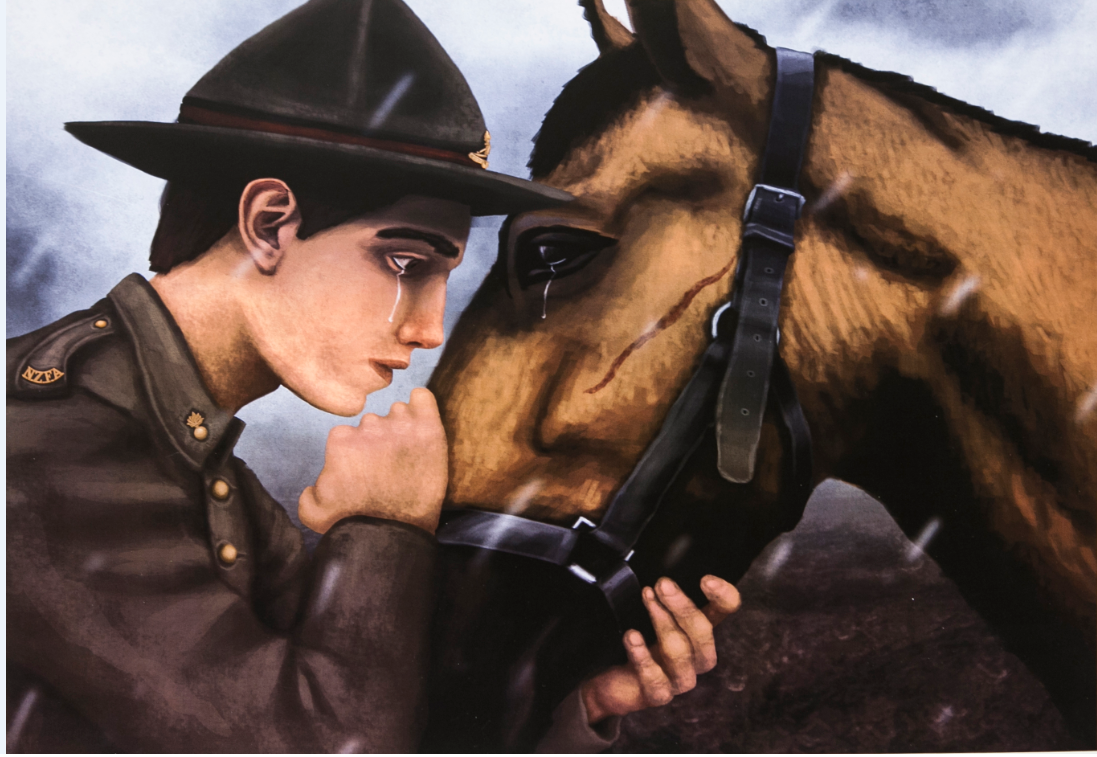
Rotorua had one known soldier who served in World War One as a Field Artillery driver. Cecil Henry Goodson, as a driver,  was in charge of caring for the horses . Unfortunately, Cecil did not come home, dying on 5th September 1918  in France aged 20.  In 2018, Jared Lewis entered the following artwork using the soldier profile of Cecil Henry Goodson in the Museum's Art of Remembering competition for which he won an Excellence in Art Award.

Cecil Henry Goodson and horse. Thanks to Jared Lewis

Another famous World War One character was Caesar, a bulldog who was the mascot of the 4th Battalion (A Company) New Zealand Rifle Brigade. Caesar was a  Red Cross dog, trained to look for wounded Allied soldiers. His owner and handler was Tom Tooman. Tom survived the war, but unfortunately Caesar was shot and died while helping a wounded New Zealand soldier. Caesar's official collar, misspelt as "Ceaser" is held at the Auckland War Memorial Museum. On 27 February 2019 the National Army War Museum in Waiouru awarded Caesar the Blue Medal. This is an award for bravery and Caesar is the first recipient.

Caesar. Image permission kindly provided by Patricia Stroud. 'Caesar, the Anzac dog',
 URL: https://nzhistory.govt.nz/media/photo/caesar-the-anzac-dog, 
(Ministry for Culture and Heritage), updated 11-Jun-2019

The library holds a variety of material featuring animals and humans working together in times of war. Below are some recommended reads:

Children's Illustrated Work STR

Children's Fiction BRO

Children's Illustrated Work BEC

YA Fiction KIW

1st floor DVD Collection
940.426 ANZ


Here in Rotorua, our group of Wacky Warmers who meet weekly at the Library, have created all the knitted purple poppies. We are very thankful to Lorraine and the other ladies.

Purple poppies created by the Wacky Warmers knitting
 group who meet weekly at Te Aka Mauri


This blog was written by Trish. Thanks to Heritage New Zealand, Patricia Stroud, Susan Brocker, Rotorua Museum, Jared Lewis, Terry Kinloch and the Rotorua Wacky Warmers.

For further information about different and additional animals who served alongside our forces please visit the following websites:

www.aucklandmuseum.com/war-memorial/online-cenotaph/features/Mascots

https://nzhistory.govt.nz/war/mascots/first-world-war-mascots

https://www.armymuseum.co.nz/mans-best-friend/


Friday, 19 April 2019

Anzac Biscuits


Anzac Day is a national day of remembrance in Australia and New Zealand that recognises all New Zealanders and Australians who have served during wars, conflict and peacekeeping operations. Anzac Day originally honoured those who served in the Australian and New Zealand Army Corps (ANZACs) and fought at Gallipoli during World War I.

The Anzac Biscuit has long been attached to Anzac Day and is seen as a symbol of national identity in both New Zealand and Australia.

But there is much debate over the origins of the biscuits and whether they were eaten by soldiers during the First World War.

In her book Anzac Biscuits: the power and spirit of an everyday national icon, Allison Reynolds reviewed research into the history of Anzac biscuits.

In 1999 University of Otago Emeritus Professor Helen Leach asserted that there was 'no evidence' that Anzac biscuits were included in parcels sent to soldiers in World War I. Australian food historian Barbara Santich agrees with this writing 'there is no evidence that Australian women packed tins of homemade biscuits and dispatched them off to loved ones in the trenches.'


Dr Sian Supski on the other hand argues that it seems likely that a biscuit resembling an Anzac biscuit was sent. Supski references The Australian Comforts Fund, which requested that biscuits and cakes be packed in sealed tins.

In 1994 the New Zealand Listener shared an anecdote that a reader's mother remembered helping her own mother pack Anzac biscuits into large golden syrup tins during World War I to send to the front.

The New Zealand National Army Museum argues that Anzac biscuits being sent to the troops is a myth but does acknowledge that there is some evidence that a rolled oats biscuit was sent to troops on the Western Front but this 'was not widespread'.

Reynolds was unable to determine a definitive answer. She was also unable to determine when the name Anzac biscuit came into place despite extensive research. Reynolds asserts that not long after the 1915 Gallipoli campaign foods such as biscuits, cakes, and puddings had patriotic terms like Anzac or Gallipoli in them.

It is agreed that Anzac biscuits were largely sold at public events to raise funds to support the war effort. Today Anzac biscuits are still used as a fundraising effort for both Royal New Zealand Returned Services' Association (RSA) and the Returned and Services League of Australia (RSL).

Below are some Anzac biscuit recipes from the 1930s and a modern recipe to try yourself!


Anzac Biscuit recipe, Patea Mail, 20 October 1930. Courtesy of Papers Past. Note the spelling of coconut.

Anzac Biscuit recipe, Northern Advocate, 4 July 1939. Courtesy of Papers Past.


Simple modern Anzac Biscuit recipe


Ingredients

1 cup rolled oats
1 cup desiccated coconut
1 cup flour
1 cup sugar
125 g butter
2 Tbsp golden syrup
1 tsp baking soda
2 Tbsp boiling water

Method

1. Preheat the oven to 180°C (160°C fan bake). Lightly grease 1-2 baking trays or line with baking paper.

2. In a large bowl, sift the flour. Stir in the rolled oats, coconut and sugar to combine. Make a well in the centre.


3. In a saucepan, melt the butter and golden syrup together.


4. Dissolve the baking soda in boiling water and then add to butter mixture.


5. Pour the butter mixture into the dry ingredient and mix to combine.


6. Roll spoonfuls of the mixture into balls and place on the oven tray, allowing enough room for biscuits to spread while cooking. Press biscuits down lightly with a fork.


7. Bake in the preheated oven for 12 - 15 minutes, cooking one tray at a time. Remove to a wire rack to cool, and enjoy!

This recipe is simple because for the dry ingredients it follows the one cup rule - 1 cup rolled oats, one cup desiccated coconut, 1 cup flour, 1 cup sugar. You may wish to get creative and add other ingredients, such as vanilla essence, almonds, pumpkin and sunflower seeds, dried fruits (sultanas, cranberries etc).

This blog was written by Graeme. Thanks to Papers Past, The New Zealand Army Museum, Anzac Biscuits: the power and spirit of an everyday national icon by Allison Reynolds. Anzac Biscuit photographs taken by Graeme Cash.