Showing posts with label Te Arawa. Show all posts

Monday, 8 May 2023

Nga Purakau o Te Arawa

Stories of  Te Arawa 

In Aotearoa, ngā pūrākau (creation narratives) are an ancient form of transmitting and creating shared meaning through storytelling.

These creation stories provide a way of looking at our world and environment through a Māori lens. They stand as a model for individual and collective identity, behaviour and aspirations.
Te Arawa ancestors have rich pūrākau, which help us understand origins that are embedded with wisdom and universal lessons to navigate through many of life’s transitions. In these pūrākau, heroines and heroes act as exemplars of human potential, insight and understanding.

I share, with permission, three of the purakau of Te Arawa:

Hatupatu and Kurangaituku

I a Hātupatu e mahi manu ana i te ngahere, ka kite ia i tētehi mea tino rerekē. He wahine e tino rite nei ki te manu. He parirau i ōna ringa, he maikuku roa i ōna matimati, kāore hoki ōna ngutu tangata, heoi, he ngutu manu roa kē i whakamahi ai ia hei tao ki te mahi manu.

Hatupatu was spending the day alone in the forest hunting for birds when he came across a very unusual scene. A short distance away, Hatupatu saw a strange woman with wings on her arms and claws where her fingers should be.  Instead of soft lips, the woman had a mouth like a bird’s beak and was busily using it as a spear to catch birds.

To read the full story go to the Great Te Arawa Stories website: www.gtas.nz.


Maggie Papakura on porch of 'Rauru' house. c.1904. Photograph by Arthur James Iles (b.1870, d.1943). Rotorua Museum Te Whare Taonga o Te Arawa (CP-182)


The above photograph is of Nelson's Carved House 'Rauru" at Whakarewarewa before he sold it in 1910. 

A journalist wrote the following about this carved house:

Captain Nelson has been able to construct a carved house which is certain to create a considerable amount of antiquarian interest.

 The journalist continues:

The single door and window with their frames are beautifully carved and unlike the other wood are coloured black. On the heavy sliding door consisting of a single Kauri slab, is depicted the grotesque and fearful image of the witch Kurangaituku... the window upon which appears the figure of her husband. (Auckland Star, 1906.)


'Rauru' can be visited today at the Museum für Völkerkunde Hamburg.

A little more about Hatupatu


Hatupatu's story does not begin and end with his near fatal experience with Kurangaituku, it seems he was also known as a conservationist, he is described here by Don Stafford: 

Hatupatu lived on Mokoia Island with his parents, but he often travelled across to Rotoiti and Maketu. “He always wore a tupare and often if he liked a place, he would pluck a twig from it and plant it there. That’s what he did here at Ngaukawakawa”

Another tale told is of Hatupatu’s attempt to bring snapper and acclimatise some seventy he had netted at Maketu in Lake Rotorua, sadly though only one snapper survived the trip: 

It was immediately released into the water, whereupon (tradition says) it swam out into the lake, circled Mokoia Island once and returned to the point of its release, beached itself then died’ (Stafford 1999, p.42)
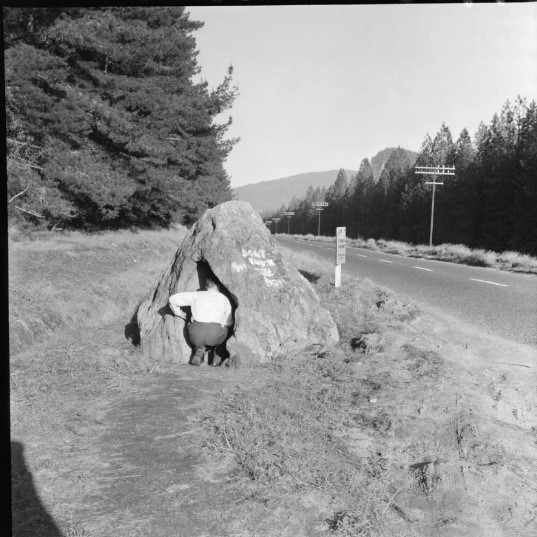


Hatupatu's historic landmark rock on the Taupo Putaruru Highway. Evening post (Newspaper. 1865-2002): Photographic negatives and prints of the Evening Post newspaper. Ref: EP/1958/1863-F. Alexander Turnbull Library, Wellington, New Zealand. /records/23247524

The travels of Kahumatamoemoe and Ihenga

Ko Kahumatamomoe te tama a te rangatira o te waka o Te Arawa, a Tamatekapua.  I ū rāua tahi ko tāna irāmutu, ko Īhenga mā runga i te waka rā ki uta i Maketū.
Nōna e takahi ana i te nuku o te whenua ki tuawhenua, nā Īhenga ngā moana o Te Rotoiti-i-kitea-ai-e-Īhenga me Te Rotorua-nui-a-Kahumatamomoe i tapa i mua i tana wehenga ki te kite i ōna tuākana, i a Taramainuku rātau ko Warenga ko Huarere i noho ai i Te Tai Tokerau.
 
Kahumatamomoe was the son of Tamatekapua, captain of the Arawa waka. He arrived on the waka at Maketū, with his nephew Īhenga.
 
On his journey inland, Kahumatamomoe named Te Rotoiti-i-kitea-ai-e-Īhenga (Lake Rotoiti) and Te Rotorua-nui-a-Kahumatamomoe (Lake Rotorua) before heading off to visit Īhenga’s older brothers, Taramainuku, Warenga and Huarere, who lived in the far north.

To read the full story go to the Great Te Arawa Stories website: www.gtas.nz.


Rāwiri Taonui, 'Ngā waewae tapu – Māori exploration - Te Arawa explorers', Te Ara - the Encyclopedia of New Zealand, http://www.TeAra.govt.nz/en/map/14143/kahumatamomoe-and-ihengas-journeys (accessed 14 March 2023)


Ihenga and the patupaiarehe

I ngā rā o tuawhakarere, ko Te Tūāhu-a-te-Atua i te tihi o Ngongotahā te kāinga o tētehi iwi porehu.  E ai ki te kōrero, he iwi ira atua i mau ai i a rātau te mana atua, ka mutu, i mōhio whānuihia te iwi rā e kīia nei ko te Patupaiarehe.

Long ago the summit of Ngongotahā called Te Tūāhu a te Atua (The Altar of the God) was the home of a mysterious people called the Patupaiarehe. They were thought to be an iwi atua or people of supernatural powers. To some they were known as the ‘fairy people’.

To read the full story go to the Great Te Arawa Stories website: www.gtas.nz.

In the following image of a 1913 survey map the Fairy Spring is clearly marked.


Land  Information New  Zealand (LINZ) and licensed by LINZ for re -use under the  Creative Commons  Attribution 4.0  International licence.


This post was written by Alison


Sources:

Stafford, D. M. (Donald Murray). (1999).  Pakiwaitara: Te Arawa stories of Rotorua. Reed.
Hatupatu and Kurangaituku. (n.d.). Retrieved March 14, 2023, from https://www.gtas.nz
Travels of Kahumatamoemoe and Ihenga (n.d.). Retrieved March 14, 2023 from
https://www.gtas.nz
Ihenga and the patupaiarehe (n.d.). Retrieved 14 March, 2020 from https://www.gtas.nz
New carved house at Whakarewarewa (1906, January 15).  Auckland Star. 
Institute of Cadastral Surveying Inc. (1913) [Survey plan of part of Rotohokahoka D North No.2A Block]. [Map] Retrieved April 19, 2023 from Cadastral Index.


Tuesday, 21 June 2022

The Call to Navigate the Stars

Me mātau ki te whetū, I mua kōkiri o te haere

Before you set forth on a journey,

Be sure you know the stars 


The study of the cosmos is a pursuit of knowledge that unites all peoples from around the world. This year marks the first year that Matariki will be acknowledged as a national holiday in Aotearoa. In recent years Matariki has become a time for all people to celebrate through Māutauranga Māori (Maori Knowledge) but also to celebrate and share their own uniqueness and culture (Matamua,2018). The Te Arawa confederation has been provided by its forbearers a rich navigational history that serves as trace reminders to their ascendants that we carry all we need with in us to answer the call of the stars, step into the fullness of who we are and successfully navigate the path of our own dreams (Ihimaera, 2020).

The migration from Hawaikii to Aotearoa was an incredible act of courage and unrivalled feat of oceanic navigation. Maketū holds special significance for Te Arawa being the landing place of the great Te Arawa waka (Tapsell, 2017). Memorialising this significant history is the Maketū monument. Built at a site remembered as Ōngatoro in 1940; it rises from a stone base with eight sides representing the children of Rangitihi thus the descendants of Te Arawa. Incorporated into its construction are pieces of granite slab from the Coromandel where the commander Tamatekapua is buried. Stones are stacked to form the memorials spire, in memory of the great navigator and high priest explorer Ngā-toro-i-rangi who was the first to step off onto land and conduct rituals beneath the Pōhutakawa tree in full bloom. It is said two stone anchors used to stabilise the great waka were in the Maketū estuary, marking the place where the waka landed.

Fig.1.1/2-032743-F https://teara.govt.nz/en/photograph/5571/maketu-memorial 
National Library of New Zealand

Māori sea fearing culture is deeply embedded in our Polynesian roots. Māori relied on non-instrumental navigation amongst other techniques and technologies that were taught and passed on like Tātai Arorangi (star lore), whakairo (carving) and toi raranga (weaving) (Bader, McCurdy, Chapple,1999). Polynesian navigators relied on the position of the stars to guide them along on their voyaging routes. Navigators knew stars held their positions steady in the sky throughout the year, although at times stars would rise, or set, changing seasonally like that of the Matariki constellation. The star map known as Kāpu whetū was an adaption made by navigator Jack Thatcher for navigators from Aotearoa (Inia, 2018).  

Fig 2.Sited https://teara.govt.nz/mi/diagram/2222/kapehu-whetu

The star map known as Kāpu whetū was an adaption made by navigator jack thatcher adapted from a Polynesian adaption which was originally sourced from the original Micronesian star map designed and used by navigator Mau Piailug

Devastatingly the affects of colonisation infiltrated all aspects of Māori society. The Polynesian achievements and skill required in voyaging the pacific were both denigrated and romantiscised (Walker, 1990). Many cultural practices such as star lore, and the technologies associated with voyaging were either lost and or forgotten almost to the point of distinction (Inia, 2018)


Fig 3. https://nzetc.victoria.ac.nz/tm/scholarly/BesCano-fig-BesCano257a.htm


However due to the steadfast commitment of those cultural practitioners dedicated to the reclamation of mātauranga Māori a revitalization of these aspects of Māori culture has experienced a renaissance. An exemplar of this work is that of master carver Matahi Whakataka-Brightwell of Te Arawa descent and Tahitian master navigator Francis Cowan who joined forces building a double hull waka which was gifted the name Hawaiki Nui I. (Gill, 2011). This prestigious maritime vessel was crafted utilising customary knowledge, tradition and skills. Whole lifetimes of experience and years in the making it was in 1985 that Matahi, Francis and three others set off on this historically momentous journey sailing and retracing the route of Te Arawa-Tainui from Tahiti to Rarotonga then South-west to Aotearoa. Reinvigorating the voyaging techniques of their ancestral navigation predecessors, using the stars, reading all the signs and wonders of their oceanic environment as their guide (Whakataka-Brightwell, 1994).

Fig 4. Ko Matahi Avauli Whakataka-Brightwell me te Waka Hawaiiki-nui, Pahiatua
Photo credited to Stuff Limited


Fig 5. 1/2-032743-F https://teara.govt.nz/en/photograph/5571/maketu-memorial Maori canoe builders at work on Hawaiki-Nui - Photograph taken by Ross Giblin. Dominion Post (Newspaper): Photographic negatives and prints of the Evening Post and Dominion newspapers. Ref: EP/1981/0778/35A-F. Alexander Turnbull Library, Wellington, New Zealand. /records/22840685

Fig 6. Ko Matahi Avauli Whakataka-Brightwell me te Waka Hawaiiki-nui, Pahiatua
Photo credited to Stuff Limited

Ancestral knowledge is encrypted in taonga tuku iho (ancestral expressions of cultural value that are handed down) they are intrinsically imbued with tangible and intangible qualities like (philosophy), tikanga (custom and lore) and karakia. Re-discovering these path ways of knowledge is like accessing a cultural archive (Starzecka, D.C, Neiche, R. Pendergrast, M. 2010)
. With only one example of Māori waka sail in existence, named Te Rā and housed in the British Museum. It is only in recent years that attention has been focused on the weaving technology incorporated into the production of sails for these maritime vessels an essential component to the success of these Pacific voyaging migrations which would not otherwise have been able to happen. Future generations can benefit and become part of the ongoing reclamation of this knowledge (Starzecka, D.C, Neiche, R. Pendergrast, M. 2010).

 
Fig 7. Image sited: https://nzetc.victoria.ac.nz/tm/scholarly/BesCano-fig-BesCano257a.html


Kia Whakatōmuri te Haere Whakamua. 

I walk backwards into the future with my eyes fixed on my past.


This whakataukī or 'proverb' speaks to Māori perspectives of time, where the past, the present and the future are viewed as intertwined, and life as a continuous cosmic process (Walker, 1990).

In 2022 three Te Wānanga o Aotearoa staff have been awarded doctorates in raranga (traditional Māori weaving) through Auckland University of Technology’s Te Ipukarea Research Centre. Their unique joint project - covering raranga past, present and future required each to individually work towards their PhDs through completing research and creating raranga. Each piece of work produced could stand on its own merit but also worked together creating a collective body of work. 

The overarching kaupapa of the joint PhDs project was the role of kairaranga – who were essential in the effective functioning of Māori society - from the past to the future. Amongst many other customary cultural practices our navigational technologies were almost made extinct. However it is worthy to remember within our great migrations from Polynesia also came with us an abundant basket of knowledge that was adapted and evolved to suit the new conditions and resources of this land.

Fig 8. Photos attributed to Te Wananga o Aotearoa - From left to right: Gloria Taituha, Jacqueline McRae-Tarei and Rose Te Ratana at a recent display of their work, Standing under waka sails woven by Jacqueline.Left photo below Rose Te Ratana

 and to the right Gloria Tohutu


Producing a collective time line of work reflecting this understanding and transmission of knowledge Jacqueline McRae-Tarei, a Kaiwhakahaere Ako in Kawerau, looked at historical raranga up to 860 and created sails. Gloria Taituha, a Te Awamutu-based Poururuku, studied the period from 1860 to 1970. Rose Te Ratana, a kaiako from Rotorua, researched raranga from 1970 and into the future and looked more deeply into whāriki. In an interview with the Waikato Herald the ladies commented “Raranga isn't just decorative – it was essential to the successful migration of Māori to Aotearoa and their life here amid a colder climate. So, we acknowledge our tīpuna kairaranga from the distant past as well as more modern and contemporary practitioners who have carried the practice forward (Herald, 2021)

So thanks to the focus, dedication and commitment of cultural practitioners such as these kairaranga and all those that have gone before them and will come after; their research creates an important body of work about the practice of raranga across time and its path into the future. They become part of the continuum of this story carrying their past into their future and in their continued practice and transmission of the practice of raranga they strengthen the connection to the ancestors who are ever present existing both in the physical and spiritual aspects of their work and ensuring its legacy for generations to come.


-------------------------

Bibliography
Walker, R. (1990). Ka Whawhai Tonu Matou: Struggle without end. Penguin.
Matamua, R. (2018). Matariki the star of the year. Huia.
Ihimaera, W. (2020). Navigating the Stars: Māori creation myths. Penguin.
Whakataka-Brightwell, G (1994). Waka. Learning Media Ltd.
Inia, R. (2018). E Oho. Te Mau Aroha.
Bader, H-D., McCurdy, P., & Chapple, J., (1999). Proceedings of the waka symposium 1996: Voyages from the past to the future. Te Huiteananui-A-Tangaroa, New Zealand Maritime Museum
Gill, M. (2011). New Zealand Hall of Fame:50 Remarkable Kiwis. New Holland
Starzecka, D.C, Neiche, R. Pendergrast, M. (2010). Te Papa Press


Paul Tapsell, 'Te Atrawa - Serttlement and Migration', Te Ara - The Encyclopedia of New Zealand, http://www.Te Ara.govt.nz/en/photograph/1515/te-arawa-monument-maketu(accessed 20 June 2017)
Maketu Te Arawas first settlement, https://www.gtas.nz/maketu
https://www.nzherald.co.nz/waikato-news/news/unique-triple-achievement-as-wahine-awarded-doctorates-in-traditional-maori-weaving/U6KGLIREA643IBGIBZLJABD3IY/

Fig.1.1/2-032743-F https://teara.govt.nz/en/photograph/5571/maketu-memorial National Library of New Zealand
Fig 2.Image attributed to https://teara.govt.nz/mi/diagram/2222/kapehu-whetu
Fig 3. https://nzetc.victoria.ac.nz/tm/scholarly/BesCano-fig-BesCano257a.htm
Fig 4. Ko Matahi Avauli Whakataka-Brightwell me te Waka Hawaiiki-nui, Pahiatua. Photo credited to Stuff Limited
Fig 5. 1/2-032743-F https://teara.govt.nz/en/photograph/5571/maketu-memorial Māori canoe builders at work on Hawaiki-Nui Photograph taken by Ross Giblin. Dominion Post (Newspaper): Photographic negatives and prints of the Evening Post and Dominion newspapers. Ref: EP/1981/0778/35A-F. Alexander Turnbull Library, Wellington, New Zealand. /records/22840685
Fig 6. Ko Matahi Avauli Whakataka-Brightwell me te Waka Hawaiiki-nui, Pahiatua. Photo credited to Stuff Limited
Fig 7. Image sited: https://nzetc.victoria.ac.nz/tm/scholarly/BesCano-fig-BesCano257a.html
Fig 8. Photos attributed to Te Wananga o Aotearoa

Friday, 5 April 2019

Easter


As we approach the season of Easter, I thought, what would we discover looking back at old papers of how Easter was celebrated here in Rotorua over the years?

17 April 1895 from the Hot Lakes Chronicle describes a Sunday School picnic held on Easter Monday by the Presbyterian church. The article talks of "an abundance of good things provided" but there's no specific mention of Easter Eggs, chocolate or the Easter Bunny.

Hot Lakes Chronicle 17 April 1895, p 2

As well as information about different services that would be held on the Good Friday and Easter Sunday, sporting events (such as the Yachting regatta) were announced, and notice of shop services alterations for the four days were advised in 1956. Mention is made of the availability in the shops of "Novelties...Easter eggs, bunnies and chickens for the children". More weight is given to the church services that will be held.

Daily Post 28 March 1956


Daily Post 28 March 1956


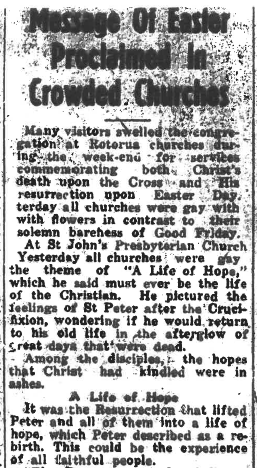
Following the Easter weekend of 1956, there was a description in the paper of packed churches and accounts of the different services held by the Presbyterian, Anglican and Catholic churches.

Daily Post 2 April 1956, p 1

In the Photo News of May 1965, there are photos of churches in a Procession of witness leading to a combined service. Was this part of the Easter or pre-Easter celebrations? If anyone should know, the library staff would love to hear from you.

Photo News 8 May 1965, p 7

The Easter Yachting Regatta is still going strong in 1965...


Photo News 8 May 1965

and there's now Powerboat Racing as well.


Photo News 8 May 1965

Easter treats in the form of Easter Eggs were delivered to children in the cerebral palsy unit of Queen Elizabeth Hospital hospital by the Easter bunny, courtesy of Jaycees.

Photo News  7 April 1967, p 19

An Easter tomb with the stone rolled away was constructed at the entrance to the Rotorua City Christian Fellowship, to remind people that "Easter is about the death and resurrection of Jesus"


Daily Post 2 April 1994, p 2

In 1995 children were read to by the Easter Bunny during a Library holiday programme.

Daily Post 12 April 1995, p 1

At Cantabria, residents got into the fun of making and decorating hats for the annual Easter bonnet parade.

Daily Post 13 April 1995, p 1

"Passion in the Park", a multi-denominational passion play was presented at the Lakefront in 1997. The previous year, the production was in the FRI grounds.

Daily Post 27 March 1997, p 2

By 1998, the Antiques fair was held  in Rotorua over Easter weekend, with lots of folks in attendance at the Rotorua Convention Centre.

Daily Post 14 April 1998, p 1

Not just the young received Easter goodies. The Rotorua Host Lions Club delivered Easter gifts of hot cross buns, sweets and fruit to residents of pensioner flats.

Daily Post 22 April 1998, p 9

At St Lukes Anglican church, Music for Passiontide was performed on Good Friday, while Destiny church also had an Easter production, Rezurrection Road on Easter Sunday.

Daily Post 11 April 2001, p 12

The Daily Post, on 24 April 2001, had a special lift-out, Te Arawa Day: a celebration of the tribe's blessing. The Easter Monday had been a special celebration day for iwi

Daily Post 24 April 2001

The Don Stafford Rooms holds the Photo News which can be freely viewed. Microfiche of old Daily Post newspapers may be also viewed on the 2nd floor. Library staff are happy to assist.
With thanks to the Daily Post and Photo News. This blog written by Trish.

Friday, 30 November 2018

Book Reviews for new & related to World War 1 items

Kiwis at War series: This series of Teen books, written by popular New Zealand authors, gives a fictionalised overview of the First World War and the involvement in all aspects of it by Kiwis. Although each book is written by a separate author, characters slip seamlessly between the different books, bringing the characters to life. Don’t let the Teen label put you off – these are a great read!

1914: Riding into war by Susan Brocker, follows Billy and his best mate Jack as they join the Mounted Rifles Regiment along with their horses. The story begins with the difficulties encountered in keeping their horses alive and healthy during the sea voyage from New Zealand to Egypt, and then the eventual move minus their horses to Gallipoli.

1915: Wounds of war by Diana Menefy, is the story of Mel and her cousin Harriet, who join the NZ Army Nursing Corps. They set sail for Egypt then serve on Hospital ships involved in caring for wounded soldiers from Gallipoli. Letters flow between home and the ships, nurses on the different ships, giving insights into conditions, workloads and even shore leave.

1916: Dig for victory by David Hair. When Leith from Otago learns that the Mounted Rifles are to be combined with the Maori soldiers into the New Zealand Pioneer Battalion, he’s not happy, especially as they’re to be digging trenches! As well as dealing with a bullying Sergeant, Leith becomes friends with a young Maori soldier, Tamati, and we get to meet some famous names. Together they deal with the dangers and horrors of building trenches in France, and then with a treasonous officer.


1917: Machines of war by Brian Falkner. New Zealander Bob Sunday's story opens in La Bellevue, France, where he is bring driven to the RAF aerodrome to begin his posting as an observer/gunner. Disturbed by a strange throbbing sound, he and his fellow recruit realise German bombers are headed to the aerodrome. The story unfolds, revealing life as part of a flying squadron, where young men fought in the air, often with a short flying career.   


1918: Broken poppies by Des Hunt. Henry Hunt, a Kiwi soldier is close to enemy lines in the trenches on the battlefields of France. When he rescues a little terrier dog, Henry faces a disciplinary hearing. To his relief, Poppy is allowed to stay, for along with comfort for the soldiers (and a belief in their safety while with them), she’s a good ratter and hunter.  Once again, we are exposed to descriptions and emotions of a hellish time where many were broken.


An ANZAC in the family: Private McAlpine of the 4th reinforcements by Sherryl Abarahart 940.412 MCA, Reference only

Expat New Zealander Sherryl Abrahart has extensively researched the story of her uncle Private Leslie McAlpine, who served in the 4th reinforcements during the First World War. He survived the battlefields of Gallipoli and the sinking of the Marquette, but was tragically killed in action on the Western Front on the 8th July 1916, aged 19. He is buried at Cite Bonjean Cemetery, just outside of Armentieres.

The softcover book also features over 60 black and white photographs, as well as maps, digitised newspapers clippings, military records and other ephemera from the time.  


Listener, 10 November 2018
An article on page 28 mentions lack of understanding for medical personnel on their return to New Zealand and the ignorant attitudes of the public to their work as stretcher bearers.

Closer to home, on page 35, there is a fascinating article by Sally Blundell concerning a young Te Arawa soldier, Winiata Rewi Taphiana (Tapsell), and his part at Le Quesnoy, the place of New Zealand's famous victory.

Other recommended World War One titles

Broken branches: New Zealand families who lost three or more children in the Great War by Josh Scadden 940.467 SCA, DSR Reference only


The Bulford Kiwi: the kiwi we left behind by Colleen Brown 940.393 BRO, NZ Lending

Facing the front: New Zealand’s enduring first World War by Gavin McLean 940.393 McL, NZ Lending

Gallipoli to the Somme: recollections of a NZ infantryman by A Aitken 940.48193 AIT, NZ Lending

HMAS A.E.I’s Kiwi soldier: John Reardon – one of the first 2 New Zealanders to become submariners in 1914 by Gerry Wright 359.93 REA, DSR Reference only

Heroes of Gallipoli: gallantry of New Zealanders on Gallipoli by Richard Stowers 940.426 STO, DSR Reference only

Jack's journey: a soldier's experience of the First World War by Jack Pryce 940.48193 PRY, Lending

Make her praises heard afar: New Zealand women overseas in WWI by Anne Tolerton 940.3 TOL, NZ Lending and DSR Reference

New Zealand Methodist Chaplains and Ministers at war: the First World War through their eyes by Allan K. Davidson 940.478 DAV, NZ Lending

100 years New Zealand Military Nursing: New Zealand Nursing Service - Royal New Zealand Nursing Corps, 1915-2015 by Sherayl McNabb 940.475 McN, NZ Lending and DSR Reference

Recovery: Women's Overseas Service in World War 1 by Kay Morris Matthews 940.3082 MOR, NZ Lending and  DSR Reference

The Western Front: a guide to New Zealand battlefields and memorials by Ian McGibbon 940.427 McG, Genealogy Reference only


Thursday, 14 June 2018

Vice Regal Tours & Duties in Rotorua 1920-1950s


NZ Governors and Governor-Generals enjoy Rotorua sights

1920 – Sir Charles Fergusson & Lady Fergusson accompanied H.R.H the Prince of Wales on his official visit to the town.


As Governor, Sir Charles Fergusson, was welcomed on the 3rd February 1926, and was kind enough to open the annual bowling tourney. The party was welcomed at Whakarewarewa by Mita Taupopoki and then an extended tour of Whakarewarewa

“A smoke concert was held at Dixieland by the Mayor C. H. Clinkard in honour of the Governor-General”   Auckland Star 8th February 1926.  

On the 27th November 1929 Sir Charles & Lady Fergusson returned to Rotorua on their farewell tour.

Click here to read the article Papers Past


1930 – Governor-General Lord Bledisloe & wife were welcomed by Mita Taupopoki.

With Thanks from the Sir George Grey Special Collections,
Auckland Libraries, AWNS-19300507-45-1 

Entertainment at Dixieland was arranged by Rotorua Mayor Mr T. Jackson & Councillors. Despite the weather (rained lots) the couple were able to visit Tikitere, Lake Rotoiti and Lake Okataina and Ohinemutu. 

Lord Bledisloe also visited several primary schools in the district as well as the King George V Hospital and before leaving visited Sir Joseph Ward (NZ Prime Minister) who was in Rotorua for treatment. In 1931 His Excellency opened the Horohoro Native School.

In 1933 Lord & Lady Bledisloe were joined by Lady Norah Jellicoe, while here they attended the A&P Show and Lord Bledisloe presented the Ahuwhenua Cup (for the encouragement of Maori Farming) to Wiremu Swinton of Raukokore at a ceremony in Ohinemutu.

1935 – Governor-General Viscount Galway with his wife visited on the 6th June. 

Large reception at Ohinemutu where the Viscount was presented a Kiwi cloak, the couple then visited the Model Pa at Whakarewarewa and guided through the hot pools etc. by Guide Rangi. The following day the party visited Waiotapu and viewed the Lady Knox geyser.  Photographs published in the New Zealand Herald 10th June 1935.

Viscount Galway returned in 1939 to present the Ahuwhenua Cup to J.Edwards at Horohoro.

With thanks to the Sir George Grey Special Collections
Auckland City Libraries AWNS_19401127_p029_i001

18 November 1940 - Viscount Galway opened the newly reconstructed Wahiao wharenui, the original being constructed by Mita Taupopoki. The carvings from the original wharenui were preserved and used in the new one, however the tukutuku panels from inside were replaced with new ones made at the NZ Maori Arts & Craft’s Institute.  The reconstruction was to be finished and opened by the end of the Centennial Year.  Two others in Rotorua were scheduled, but did not open until 1943.  See Rotorua Morning Post 18th November 1940.

1941 - Governor-General Sir Cyril Newall & Lady Newall arrived 11th Oct 1941.
The Civic Reception for His Excellency was held in the Town Hall and included a Maori Concert.
He met with a parade of returned soldiers and visited the Bath House and Rotorua Hospital.
Guide Rangi showed the couple around Whakarewarewa, the party also visited Tikitere and Lake Okataina.  

In 1943 during this ‘business’ visit Sir Cyril stayed at the Okataina Fishing Lodge. 
Opened the ‘new’ Tawakeheimoa at Awahou in the morning and the ‘new’ Tama te Kapua at Ohinemutu in the afternoon. 

Governor General Sir Cyril Newall giving his address at the opening of the Centennial Memorial meeting house Tawakeheimoa at Te Awahou Marae, Lake Rotorua. Ref: 1/4-000237-F. Alexander Turnbull Library, Wellington, New Zealand. /records/22431643

Centennial Memorial meeting house Tawakeheimoa at Te Awahou Marae, Lake Rotorua.
Ref: 1/4-000237-F. Alexander Turnbull Library, Wellington, New Zealand.
He also presented the “Boy Scout Assn. Gilt Cross to Arawa Troop of Boy Scouts, Patrol-Leader Rihari Haira in recognition of his prompt, courageous, and meritorious action in rescuing an infant from drowning”.  Evening Post, 22 March 1943.

1946 – Lady Mountbatten visited Rotorua and welcomed at Tama te Kapua.
During her visit she went to the Services Convalescent Hospital (now QE Spa) to speak with the soldiers, some of whom, she remembered seeing in hospitals in Italy.

She also ‘took the salute and carried out an inspection of the district St John’s Ambulance, Nurses and Cadet Units.

Thanks to the K Taylor Collection
Kete Rotorua

1946 – Governor-General Sir Bernard Freyberg, V.C. and Lady Freyberg stayed at the Okataina Lodge.  15th November – 26th November for a holiday after the official visit.

A Guard of Honour of 100 from the 2nd Cadet Battalion of the Rotorua High School parade inspected by His Excellency in front of the Municipal buildings.
Civic Welcome – outside the Municipal Buildings, where the Municipal Band played the National Anthem.  The Boy and Girl Scouts in uniform will supply the Guard of Honour at the Municipal Theatre at 2.30pm.

On Monday afternoon their Excellency’s visited the Public Hospital & Services Conv. Hospital and in the evening at Tama te Kapua a full welcome by Ngati Whakaue.

On Saturday their Excellency’s inspected a parade in front of Blue Baths – of Rotorua and Ngongotaha divisions of St John’s Ambulance.  Followed by a Private luncheon at Crowther House after which Sir Bernard opened the new social hall attached to Crowther House.

Sir Bernard and family made a number of visits to ‘take the waters’ and returned for a Civic Farewell in 1952.

1949 – Sir Willoughby Norrie & Lady Norrie visit with Governor of South Australia spent a fortnight in the district enjoying bathing in the hot pools.

1953 – Governor-General Sir Willoughby Norrie & Lady Norrie with their family arrived 12th May for their first official visit.
On arrival a reception at the Airport was led by 40 members of the Rotorua Pony Club, their excellences’ and children walked along the line patting ponies and talking to riders on both sides of the walk. The club presented Sarah and Annabel Freyberg with membership badges of the club. The children met up with the club again later at the A&P showgrounds.

The Civic Reception was held on the steps of the Town Hall and the Maori Welcome at Whakarewarewa that same day.  The next day the family went sightseeing.

1958 – Governor-General Viscount Cobham and Lady Cobham arrived on the 3rd March to the obligatory Civic Reception outside the Municipal Chambers, the Daily Post records that "there were 1000 citizens present in the bright sunshine".  In the afternoon Lord Cobham was a guest a the R.S.A.

"Rotorua welcomes Lord and Lady Cobham" When he visited Rotorua in 1935 as a member of the touring M.C.C cricket team, he never imagined that one day he might return to New Zealand as the Queen's representative... When he was last here, he said, he vividly remembered stepping back rapidly from a steaming couldron of sulphurous water when Guide Rangi told him the ground on which he was standing was less than half an inch thick" Rotorua Daily Post 3 March 1958. 

The next day His Excellency visited Rotorua High School to address some 4000 children, from all the schools in Rotorua and the Boy Scouts, Cubs, Girl Guides and Brownies also in attendance in uniform. His Excellency endeared himself much to the children by asking for a holiday for the children.  "Their Excellencies then left the dais and moved about among the children....his aide-de-camp, Lieutenant Durden-Smith stole the show, "large groups of wide-eyed children who were fascinated by his uniform and the pendant aiguillettes" 

In April His Excellency paid a visit to the Easter Sea Scout Camp at Te Ngae. His Excellency and family stayed at Moose Lodge for a brief holiday in 1961.


Governor General Lord Cobham at the Kelliher art exhibition. Dominion post (Newspaper) :
Photographic negatives and prints of the Evening Post and Dominion newspapers.
Alexander Turnbull Library, Wellington, New Zealand. /records/22762499
With thanks to the Don Stafford Collection, Papers Past and DigitalNZ for the information and images.