100 years of Rotorua / by Ian Rockel
This book was published in 1979 by then Rotorua Museum director Ian Rockel, ahead of the 1980 Rotorua Centenary.
Rockel divides the book into sections looking at various aspects of Rotorua's history including growth, tourism, industry, forestry, people, construction, transport, government, farming, church, and the district's founding settlers.
The book also features over 150 photographs illustrating the history of Rotorua's first 100 years.
 |
| This book can be found on the 1st Floor, NZ History / Travel and 2nd Floor Rotorua Heritage at 993.423Z ONE |
This book review was written by Graeme
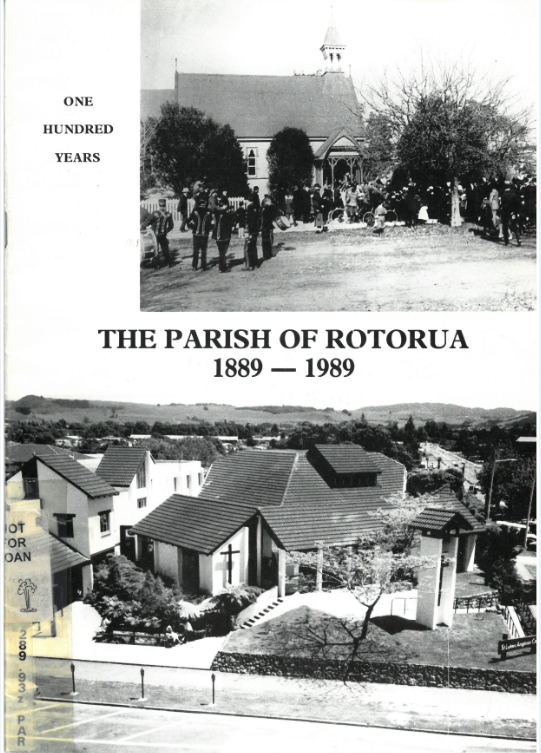
The Parish of Rotorua, 1889-1989: 100 years by St Luke's Church, Rotorua
This book was published to celebrate 100 years of St Luke's Anglican Church in Rotorua. The cover shows the original St Luke's (circa. 1905) and the replacement St Luke's which opened in 1975.
Beginning with a brief history of early missionaries in Rotorua, the book then contains snapshots of events and meeting minutes, celebrating the years. Photographs illustrate throughout.
Features of the "new" church are described, along with a list of the vicars who had served over the 100 years.
The book concludes with a look to the future, and the centennial programme for the for the week long celebrations.
 |
| This book can be found on the 2nd Floor, in the Don Stafford Room in the Rotorua Heritage Collection at 289.93 PAR |
This book review was written by Trish
These book reviews written by Alison
The Pride of a Century: the Daily Post centennial issue, August 28, 1980
Stories are amazing and can instil in the listener or reader a sense of tradition and history. For this writer, my imagination was stimulated. I was able to see through the lens of story-telling the pride that local people have in their place, their town, their city. The issue is more the development of a township with its history of tourism and unique thermal attractions. The stories reflect a sense of pride in the people and events that shaped this place, Rotorua. Some highlights include a historical timeline spanning 630 years from the discoveries of Ihenga to the amalgamated local government body, The Rotorua District Council. One of my favourites I have to stay are the stories of the development of transport from the horse drawn to horse powered. There was one advertisement that brought back memories of the 80s and the 'big hair' fashion trend. Thank you to the "Hair Shop and Rodneys Hairdressing Salons".
Features of the issue:
City of Rotorua Museum and Arts Centre / published by
Rotorua City Council c.1969?
This booklet was published to showcase the new museum which
opened officially on the 1st November 1969.
Their aims for this museum were ‘to reflect the background
and perhaps foretell the future of this vibrant district’
‘It has been established and is supported entirely by the
Rotorua City Council in the belief that such an institution is a pre-requisite to
the cultural maturity of a growing city’
The booklet shows the grandeur of the Bath House in black
& white photographs and describes the very first exhibitions. At this time the Art Gallery was in a small
corner of the museum and was managed by the Rotorua Society of Arts.
 |
| Don Stafford, here pictured as curator of the Museum : With thanks to the Daily Post for this article published in 'Picture Post' July 1969 pg. 15 |
The Government Gardens / Philip Andrews c2005
This colourful and informative book was written by local
historian Mr Phil Andrews. His introduction sets the scene with this
description of the land before it became the Government Gardens that we know
and love today. It was described as
“dreary, swampy, scrubby place… a howling wilderness”
The Fenton Agreement which was signed in 1880 was debated
and negotiated between the Te Komiti Nui o Rotorua (The Great Committee) and
Judge Fenton on behalf of the government of the day.
Phil gives us a readable history of each of the many
features and buildings of the gardens and throughout this book there are
photographs of what it once was and how it was in c2005 as photographed mostly
by John Wheadon.
The older photographs and postcards were supplied from various
sources as noted with each image. Phil includes aerial photographs which show
the location of each historical feature in the gardens and also the wider
Sanatorium Reserve Sites.
A number of the features, buildings and memorials have been
restored to their original pristine state, with the Bath House still awaiting
earthquake strengthening and upgrade of the buildings most historic
features.
 |
| Photo by Alison Leigh 2013 |
The Pride of a Century: the Daily Post centennial issue, August 28, 1980
Stories are amazing and can instil in the listener or reader a sense of tradition and history. For this writer, my imagination was stimulated. I was able to see through the lens of story-telling the pride that local people have in their place, their town, their city. The issue is more the development of a township with its history of tourism and unique thermal attractions. The stories reflect a sense of pride in the people and events that shaped this place, Rotorua. Some highlights include a historical timeline spanning 630 years from the discoveries of Ihenga to the amalgamated local government body, The Rotorua District Council. One of my favourites I have to stay are the stories of the development of transport from the horse drawn to horse powered. There was one advertisement that brought back memories of the 80s and the 'big hair' fashion trend. Thank you to the "Hair Shop and Rodneys Hairdressing Salons".
Features of the issue:
- Thermal nurseries - garden centre
- Two Miss New Zealand's - Maureen Waaka 1962, Linda Ritchie 1971
- The creation of the township of Rotorua and local government
- Memories of how the town has changed through the eyese of local people
- Notable people in Rotorua's history: Rotohiko Haupapa, Guide Rangi, Roger Dansey
- Advertisements such as, "Aunt Janet's Prize Baking Flour"
- The land wars
- The growth at Ohinemutu
- Introducing electricity
- Congratulations from local businesses
- Te Arawa Maori Trust Board created as a result of the Tamihana Korokai vs The Solicitor General case
- Sports
- One of Rotorua's oldest drapery firms, The Gardner Group
- Tourism - unique thermal attractions i.e. pink & white terraces, thermal pools, geysers
- Mokoia Island history
- Whakarewarewa
- Transport
- The eruption
- The world wars
- Services - police
- My favourite - The Hair Shop and Rodneys Hairdressing Salons
 |
| Advertisement, The Hair Shop and Rodneys |
 |
| This centennial issue of The Daily Post can be found in the Don Stafford Room at 993.423Z PRI OVERSIZE |
The book review was written by Ani


