Showing posts with label Government Gardens. Show all posts

Friday, 4 September 2020

Tulips in Rotorua

History of tulips

The tulip was originally a wild flower growing in Central Asia. It was first cultivated by the Turks as early as 1000AD. 

The Turkish word for tulip is lale. It is believed that the botanical name tulipa is derived from the Turkish word for turban. Although it is not known if this is reference to the flower's shape or because Turks often wore the flower tucked into their turban.

Tulips were introduced to Western Europe and the Netherlands in the late 16th century. Today tulips are largely associated with Holland. Tulip festivals are well known in Holland and Holland is often called the 'flower shop of the world'.

Settlers introduced flowers to New Zealand and tulips were being advertised for sale as early as 1850. The Christchurch Horticultural Society highlighted tulips at a flower show in 1883.

Wellington Independent, 5 June 1850. Courtesy of Papers Past.
Wellington Independent. 5 June 1850. Source: Papers Past.

Tulips in Rotorua

When Governor-General, Sir Cyril Newall and Lady Newall visited Rotorua in October 1941 Lady Newell was presented a bouquet of tulips by the Mayoress.

Rotorua has always had great displays of tulips blooming around the inner city, Government Gardens, and Kuirau Park.

Tulips in Kuirau Park. Source: Rotorua Photo News, Oct 24, 1970.


Government Gardens opening day of croquet season. Source: Rotorua Photo News, Dec 14 1963


Rotorua hosted a Tulip Festival in 2014. The event was hosted annually for another 3 years. The festival saw over 100,000 tulips planted throughout the city and series of public events held.

Below are a selection of photos from the Rotorua Tulip Festival. To see more visit the library to see our September 2020 display.

Photo: Alison Leigh


Photo: Rachael Reid

Photo: Rachael Reid

Photo: Rachael Reid

Photo: Alison Leigh


This blog was written by Graeme. With thanks to the Rotorua Library Heritage Collections and Archives. Also thank you to Abigail Hartevelt, Alison Leigh, Dave Moulden, Kowhai Epapara, Kathy Nicholls, Rachael Reid (thecuriouskiwi.co.nz), and Trish Brown.

Friday, 29 November 2019

Book reviews - celebrating Rotorua's history

This week we review some gems in our collection, which celebrate Rotorua's history and people.

100 years of Rotorua / by Ian Rockel

This book was published in 1979 by then Rotorua Museum director Ian Rockel, ahead of the 1980 Rotorua Centenary.

Rockel divides the book into sections looking at various aspects of Rotorua's history including growth, tourism, industry, forestry, people, construction, transport, government, farming, church, and the district's founding settlers.

The book also features over 150 photographs illustrating the history of Rotorua's first 100 years.


This book can be found on the 1st Floor,
NZ History / Travel and 2nd Floor Rotorua Heritage at 993.423Z ONE

This book review was written by Graeme


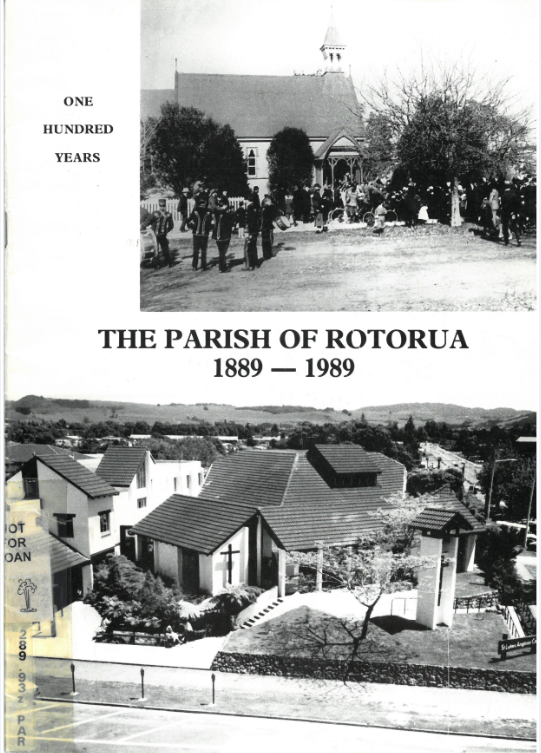
The Parish of Rotorua, 1889-1989: 100 years by St Luke's Church, Rotorua

This book was published to celebrate 100 years of St Luke's Anglican Church in Rotorua. The cover shows the original St Luke's (circa. 1905) and the replacement St Luke's which opened in 1975.

Beginning with  a brief history of early missionaries in Rotorua, the book then contains snapshots of events and meeting minutes, celebrating the years. Photographs illustrate throughout.

Features of the "new" church are described, along with a list of the vicars who had served over the 100 years.

The book concludes with a look to the future, and the centennial programme for the for the week long celebrations.

This book can be found on the 2nd Floor, in the Don Stafford Room
 in the Rotorua Heritage Collection at 289.93 PAR


This book review was written by Trish


City of Rotorua Museum and Arts Centre / published by Rotorua City Council c.1969?

This booklet was published to showcase the new museum which opened officially on the 1st November 1969.

Their aims for this museum were ‘to reflect the background and perhaps foretell the future of this vibrant district’

‘It has been established and is supported entirely by the Rotorua City Council in the belief that such an institution is a pre-requisite to the cultural maturity of a growing city’

The booklet shows the grandeur of the Bath House in black & white photographs and describes the very first exhibitions.  At this time the Art Gallery was in a small corner of the museum and was managed by the Rotorua Society of Arts.

Don Stafford, here pictured as curator of the Museum : With thanks to the Daily Post
for this article published in 'Picture Post' July 1969 pg. 15

The Government Gardens / Philip Andrews c2005

This colourful and informative book was written by local historian Mr Phil Andrews. His introduction sets the scene with this description of the land before it became the Government Gardens that we know and love today.  It was described as “dreary, swampy, scrubby place… a howling wilderness”

The Fenton Agreement which was signed in 1880 was debated and negotiated between the Te Komiti Nui o Rotorua (The Great Committee) and Judge Fenton on behalf of the government of the day. 

Phil gives us a readable history of each of the many features and buildings of the gardens and throughout this book there are photographs of what it once was and how it was in c2005 as photographed mostly by John Wheadon. 

The older photographs and postcards were supplied from various sources as noted with each image.  Phil includes aerial photographs which show the location of each historical feature in the gardens and also the wider Sanatorium Reserve Sites.

A number of the features, buildings and memorials have been restored to their original pristine state, with the Bath House still awaiting earthquake strengthening and upgrade of the buildings most historic features. 

Photo by Alison Leigh 2013

These book reviews written by Alison

The Pride of a Century: the Daily Post centennial issue, August 28, 1980

Stories are amazing and can instil in the listener or reader a sense of tradition and history. For this writer, my imagination was stimulated. I was able to see through the lens of story-telling the pride that local people have in their place, their town, their city. The issue is more the development of a township with its history of tourism and unique thermal attractions. The stories reflect a sense of pride in the people and events that shaped this place, Rotorua. Some highlights include a historical timeline spanning 630 years from the discoveries of Ihenga to the amalgamated local government body, The Rotorua District Council. One of my favourites I have to stay are the stories of the development of transport from the horse drawn to horse powered. There was one advertisement that brought back memories of the 80s and the 'big hair' fashion trend. Thank you to the "Hair Shop and Rodneys Hairdressing Salons".

Features of the issue:

  • Thermal nurseries - garden centre
  • Two Miss New Zealand's - Maureen Waaka 1962, Linda Ritchie 1971
  • The creation of the township of Rotorua and local government
  • Memories of how the town has changed through the eyese of local people
  • Notable people in Rotorua's history: Rotohiko Haupapa, Guide Rangi, Roger Dansey
  • Advertisements such as, "Aunt Janet's Prize Baking Flour"
  • The land wars
  • The growth at Ohinemutu
  • Introducing electricity
  • Congratulations from local businesses
  • Te Arawa Maori Trust Board created as a result of the Tamihana Korokai vs The Solicitor General case
  • Sports
  • One of Rotorua's oldest drapery firms, The Gardner Group
  • Tourism - unique thermal attractions i.e. pink & white terraces, thermal pools, geysers
  • Mokoia Island history
  • Whakarewarewa
  • Transport
  • The eruption
  • The world wars
  • Services - police
  • My favourite - The Hair Shop and Rodneys Hairdressing Salons

Advertisement, The Hair Shop and Rodneys

This centennial issue of The Daily Post can be found in
 the Don Stafford Room at 993.423Z PRI OVERSIZE


The book review was written by Ani

Friday, 22 November 2019

The Gardeners Cottage


Known simply as the Gardener’s Cottage, this heritage building is located in one of the most beautiful gardens in New Zealand, the Rotorua Government Gardens. This late Victorian villa was built in 1898 with two bedrooms and a lounge. Today the cottage has three bedrooms.

Front of the cottage 2019
Photograph by Ani Sharland

The cottage was originally intended as the head gardener’s house. However, the cottage has had many residents other than the head gardener. The list includes, employees of the bath house, a head attendant and a masseur, Mr J. Redward. Pat Johnston also lived in the cottage for 16 years and at that time the cottage had three bedrooms. Pat recalls people sitting on the front porch eating lunch, weddings take place in the front garden and watching marathons and the annual Anzac parade. Often gardeners who cared for the gardens dropped in and had a coffee with her.

Side view of the cottage from the carpark 2019
Photograph by Ani Sharland


The gardens of the cottage provided produce for the Te Runanga tea kiosk, the sanatorium and Waimangu House. 

The rear garden 2019
Photograph by Ani Sharland

The front garden was added in 2000 with cobblestone areas, a fountain and paved pathways.

The front garden 2019
Photograph by Ani Sharland

The cottage was the only building in the present Government Garden area until the 1900’s when a later series of developments followed. The cottage is the oldest surviving building in the government gardens. Upgrades over the years have included new interior and exterior paint and fixing the scullery roof.

Architectural feature 2019
Photograph by Ani Sharland

This post was written by Ani Sharland with thanks to Philip Andrews book, "The Government Gardens" and articles from the Daily Post.


Friday, 8 November 2019

Happy 50th Birthday to the Rotorua Museum

Fifty Years in the Bath House 

The building : a few facts
  • Bath House designed by Arthur S Wohlmann. Inspector of Works Mr. B.S. Corlett., J.W. Wrigley (Rotorua Architect) and W.J. Trigg (Draughtsman) were responsible for the plans c.1903
  • Building commenced January 1906; Official opening 13 August 1908 by Prime Minister, Sir Joseph Ward. The extra wings originally on the plan were not added at this time.
  • In 1912 the first south wing extension is opened.
Photo taken by Alison Leigh 2013.

  • The building was not kept in its original state due to lack of funding and eventually by the late 1940s the ‘Bath House’ was in a very bad state and the local Borough Council lobbied the Department of Health to do something about it. BAY OF PLENTY BEACON, VOLUME 12, ISSUE 98, 22 SEPTEMBER 1948 click this link to see what was being said.
From : Rotorua Photo News, 6 June 1964, p.2

  • Health Department handover to Rotorua City Council would eventually include 2.5 acres to build the Sportsdrome on and a sum of £60,000 to be spread over 3 years from 1963.
  • In 1964 the Sportsdrome was built and connected to the Bath House via an elevated walkway.
The Museum
  • In April 1967 Council approved the plan to convert the South Wing into a Museum.
  • Mostyn Thompson was invited to be the Museum’s establishing curator/preparator with Don Stafford appointed permanently to that position September 1968. The Museum was officially opened 1st November 1969. A mezzanine floor was introduced a this time and is where the “Colonial Display Rooms” were staged.
  • Don Stafford resigns as curator and Ian Rockel is appointed as his replacement. DP 14th July 1970. 
  • Named “City of Rotorua Museum & Arts Centre” 1970 
  • New Art Gallery opens in the north wing October 1977. 
  • Renamed “The Rotorua Museum & Art Gallery” 1979. 

    • In 1980 the recreated basement mud bath was closed due to vandalism. 
    • An extension of the ‘Tudor Towers’ building is approved in 1981.  DP 27th May 1981. 
    • In 1982 the ‘South Centennial Wing’ is recommended. After many alterations and replacements later the exterior extension was completed 1983. Official opening/naming DP 23 May 1983. 
    • The name ‘Tudor Towers’ to be dropped in favour of “The Bath House Art & History Museum” DP 21 June 1983. 
    • The Centennial Wing is redesigned and named the Te Arawa Wing. DP 29 May 1987. 

      • The Tudor Towers lease expires 2 Sept 1990, this presented an opportunity to redevelop the Bath House. 
      • In 1992 ‘The legacy of Houmaitawhiti’ exhibition is opened. 
      • In 1993 a Conservation Plan for the Bath House is commissioned. 
      • In 1994  a new name is adopted “The Rotorua Art & History Museum Te Whare Taonga o Te Arawa”

        • In 2006 The Centennial Project Stage I is completed with the reopening of the viewing platform.
        • In 2008 The Centennial Project Stage II is completed with the north wing extension opened.
        • In Sept 2011 The Centennial Project Stage III is completed and named the Don Stafford Wing. DP 3 Sept 2011.
        • ‘Rotorua Museum to remain closed following detailed assessment’ DP 7 July 2017
        • “A comprehensive assessment of Rotorua Museum has shown it falls well below earthquake safety standards and will need to remain closed for the foreseeable future.
        • The good news is that it can be fixed. How that happens, how long it will take and how much it will cost now needs to be determined.”

    The Future :
    Proposed structural strengthening  : Rotorua Museum website image
    Sources
  1. ‘Bath House, Rotorua: conservation plan’ by Works Consultancy Services Ltd. c.1993
  2. www.rotoruamuseum.co.nz
  3. 'Taking the waters: early spas in NZ' / Ian Rockel c.1986
  4. 'Rotorua Museum: Te Whare Taonga o Te Arawa: Strengthening, restoration and redevelopment'
  5. 'Rotorua Daily Post' 
This Blog post is by Alison.

Friday, 22 March 2019

Rotorua Gardens

What is it about a garden that draws the eye? Personally, I prefer gardens that looks like they've been there for years. There's lichen on the concrete, herbs spilling over the back porch and secret nooks and crannies that are a pleasure to stumble upon. Then you have the garden that has been planned with an eye for detail, to showcase it's natural and historical features.

Government Gardens 

A garden that has been planned over time is one way of describing the Government Gardens in Rotorua. Once covered in native plants like manuka, kanuka and mingimingi, it now boasts a combination of native and exotic plants, buildings, man-made ponds, geothermal areas, a gardeners cottage, monuments and a sculpture trail. This huge garden covers approximately 48 hectares of land, has a strong link to local Maori and is a historical landmark. Originally known as Paepaehakumana, it was the site of several significant battles. Now visitors can admire the rose gardens and sit in the shelter of the pavilion or watch a game of bowls.

Government Gardens 2017.
Kete Rotorua. Photograph by
Alison Leigh


Kuirau Park 

Kuirau Park is another stunning area that features a large beautiful geothermal pool. It covers 50 acreas and was gifted by Ngati Whakaue. In 1930 it became a permanent recreational reserve and was developed from a swampy scrub covered area to what it is now. Today the park is made up of an Aquatic Center, sports fields, parkland and geothermal areas. 


Toot & Whistle Train at Kuirau Park,
Rotorua. Kete Rotorua.


Inner City Beauty


Throughout Rotorua's Central Business District there are stunning displays of colour and art that draw the eye. The city gardens are maintained by a dedicated team from Rotorua Lakes Council and are scheduled for regular change. These inner city gardens also feature in some events such as the Tulip festival which is run annually and organised by 'The Inner City of Rotorua' group. During the festival, the group showcases gardens and celebrates spring by showing over 40,000 tulips.

Tulip Festival 2014, Arawa Street.
Kete Rotorua. Photograph by Alison
Leigh.

Tulip Festival 2014, Lakefront Rotorua.
Kete Rotorua. Photograph by Alison Leigh

Garden Features

The orchid gardens (now part of the Tamaki Village Gardens) once boasted a spectacular 'Water Organ' which was installed in 1988. The parts for the organ or fountain were made in West Germany, and fully assembled stood at 12 metres by 2 metres. The organ played every hour for 20 minutes at a time. 

Water Organ at The Orchid Gardens.
Rotorua Daily Post 1988, Rotorua Library Newspaper Collection.

In 1995, the Annand family found a Kaka in their garden. It was only the second to have been seen in the area in 30 years. 

Do you have photos and memories of a garden? How about sharing them on Kete Rotorua. Please contact Alison Leigh at Rotorua Library on 351-7025. 

This post has been compiled with information sourced from the Rotorua Library's newspaper collection and Kete Rotorua, and written by Ani.

Friday, 11 January 2019

Rotorua Sculpture Symposium c2014-

New Sculpture Trail in Government Gardens 

The inaugural Sculpture Symposium was held 29th November to 12th December 2014. Organised by Rotorua District Council Community Arts advisor, Marc Spijkerbosch.  Seventeen local and national sculptors worked in stone, wood or stainless steel, including guest artist Glebos Tkachenko who traveled from Russia to take part. Daily Post 24 November 2014.

The theme chosen was 'The Returning Soldier' as part of Rotorua's commemoration of WW100

Winner : Judges selected nationally recognised sculptor Anna Korver's piece 'The White Mouse'  depicting New Zealand war hero Nancy Wake, as the winning artwork which was installed on the new Sculpture Trail in the Government Gardens, she also received $10,000 as part of her prize.   Daily Post 24 November 2014.

The Rotorua Electricity Charitable Trust purchased two more sculptures for the city by local artists, these being 'Forever Remembered' by Paul Bottomley and 'Tank Trap' by Jamie Pickernell to add to the new sculpture trail. Daily Post 28 January 2015. 

Anna Korver's piece The White Mouse
Photo courtesy of Kete Rotorua

Tank Trap by Jamie Pickernell. Photo Courtesy of Kete Rotorua

Forever Remembered by Paul Bottomley
Photo courtesy of Kete Rotorua

In 2016 the next symposium was entitled 'Sulphur Lakes Sculpture Symposium' and took place 19th to 27th November 2016. 14 artists worked in an open space and locals were encouraged to go down and watch and see the artworks take shape.

The theme this time was 'The Energy Within' capturing Rotorua's geothermal and cultural environment. As with the first symposium, the winner's creation became a permanent part of the Rotorua public art collection. 

Another 3 pieces were purchased to enhance the new boulevard in Kuirau Park, they are : Takutaimoana Harawira - Kuirau : Nigel Scanlon - Ore Ore : Peter Edwards - Te Korokoro o te Parata (Throat of the Parata). All remaining work was installed on the Sculpture Trail until the next symposium in 2018.

Winner of the 2016 Symposium was local artist Trevor Nathan with his piece 'Synergy' it "reflects the interaction between rural and urban environment and how we come together as a city to create the energy in our town"
Daily Post 23 November 2016 and 3 March 2017.

Trevor Nathan 'Synergy'
Photograph by Alison L.


In 2018 the latest Sculpture Symposium was again referred to as the 'Rotorua Sculpture Symposium' and featured 18 sculptors from New Zealand, Switzerland and Iran. 

The theme was 'Nga Wai o Rotorua - The Waters of Rotorua and was run from 16th November to 26th November.

This year's winner is Rory McDougall of Hokitika with his piece 'Waters of Rotorua' made from Taranaki Andesite Stone it represents the thirteen main bodies of water alongside the rivers and hills of the Rotorua area.

A further three pieces are being considered for purchase for the public art trail.

This year there is a People's Choice option for the first time, so get on down to the gardens and vote for your favourite, you have until 17th February 2019 to get your vote on the Creative Rotorua Facebook page
Daily Post 26th November 2018.

Photographs of a few of 2018 entries, Get your vote in now


Visit the Creative Rotorua Website to download the current Sulphur Lake Sculpture Trail Brochure
and don't forget the Rotorua Public Art Trail also has some fantastic pieces of sculpture.

This post is by Alison. All photographs of the latest entries taken by Alison.