Showing posts with label Rotorua Museum. Show all posts

Friday, 8 November 2019

Happy 50th Birthday to the Rotorua Museum

Fifty Years in the Bath House 

The building : a few facts
  • Bath House designed by Arthur S Wohlmann. Inspector of Works Mr. B.S. Corlett., J.W. Wrigley (Rotorua Architect) and W.J. Trigg (Draughtsman) were responsible for the plans c.1903
  • Building commenced January 1906; Official opening 13 August 1908 by Prime Minister, Sir Joseph Ward. The extra wings originally on the plan were not added at this time.
  • In 1912 the first south wing extension is opened.
Photo taken by Alison Leigh 2013.

  • The building was not kept in its original state due to lack of funding and eventually by the late 1940s the ‘Bath House’ was in a very bad state and the local Borough Council lobbied the Department of Health to do something about it. BAY OF PLENTY BEACON, VOLUME 12, ISSUE 98, 22 SEPTEMBER 1948 click this link to see what was being said.
From : Rotorua Photo News, 6 June 1964, p.2

  • Health Department handover to Rotorua City Council would eventually include 2.5 acres to build the Sportsdrome on and a sum of £60,000 to be spread over 3 years from 1963.
  • In 1964 the Sportsdrome was built and connected to the Bath House via an elevated walkway.
The Museum
  • In April 1967 Council approved the plan to convert the South Wing into a Museum.
  • Mostyn Thompson was invited to be the Museum’s establishing curator/preparator with Don Stafford appointed permanently to that position September 1968. The Museum was officially opened 1st November 1969. A mezzanine floor was introduced a this time and is where the “Colonial Display Rooms” were staged.
  • Don Stafford resigns as curator and Ian Rockel is appointed as his replacement. DP 14th July 1970. 
  • Named “City of Rotorua Museum & Arts Centre” 1970 
  • New Art Gallery opens in the north wing October 1977. 
  • Renamed “The Rotorua Museum & Art Gallery” 1979. 

    • In 1980 the recreated basement mud bath was closed due to vandalism. 
    • An extension of the ‘Tudor Towers’ building is approved in 1981.  DP 27th May 1981. 
    • In 1982 the ‘South Centennial Wing’ is recommended. After many alterations and replacements later the exterior extension was completed 1983. Official opening/naming DP 23 May 1983. 
    • The name ‘Tudor Towers’ to be dropped in favour of “The Bath House Art & History Museum” DP 21 June 1983. 
    • The Centennial Wing is redesigned and named the Te Arawa Wing. DP 29 May 1987. 

      • The Tudor Towers lease expires 2 Sept 1990, this presented an opportunity to redevelop the Bath House. 
      • In 1992 ‘The legacy of Houmaitawhiti’ exhibition is opened. 
      • In 1993 a Conservation Plan for the Bath House is commissioned. 
      • In 1994  a new name is adopted “The Rotorua Art & History Museum Te Whare Taonga o Te Arawa”

        • In 2006 The Centennial Project Stage I is completed with the reopening of the viewing platform.
        • In 2008 The Centennial Project Stage II is completed with the north wing extension opened.
        • In Sept 2011 The Centennial Project Stage III is completed and named the Don Stafford Wing. DP 3 Sept 2011.
        • ‘Rotorua Museum to remain closed following detailed assessment’ DP 7 July 2017
        • “A comprehensive assessment of Rotorua Museum has shown it falls well below earthquake safety standards and will need to remain closed for the foreseeable future.
        • The good news is that it can be fixed. How that happens, how long it will take and how much it will cost now needs to be determined.”

    The Future :
    Proposed structural strengthening  : Rotorua Museum website image
    Sources
  1. ‘Bath House, Rotorua: conservation plan’ by Works Consultancy Services Ltd. c.1993
  2. www.rotoruamuseum.co.nz
  3. 'Taking the waters: early spas in NZ' / Ian Rockel c.1986
  4. 'Rotorua Museum: Te Whare Taonga o Te Arawa: Strengthening, restoration and redevelopment'
  5. 'Rotorua Daily Post' 
This Blog post is by Alison.

Friday, 11 October 2019

Rotorua Mile Stones & random news events recorded in Rotorua and other NZ Newspapers c1889-1980.

Rotorua as seen in the News

October 1889 & 1890 Bay of Plenty Times (BPT)

Local talks and negotiations with Government continue as they seek to purchase the new Town.  See the Fenton Agreement.

BPT 12 October 1891: The Town Board offers a £5 reward for information on the person or persons who destroyed recently planted willow trees on the Esplanade.

BPT 26 Oct 1891: Many applications are being received for business and residential sections in the new Town. Minister of Lands assures them he will arrange matters to the gratification of the applicants.

BPT 26 Oct 1894: An Auckland builder W.H. Holman’s tender to build the Rotorua Court House is accepted.

Hot Lakes Chronicle 2 October 1895 : 
 ‘The Town Board calls for tenders for the formation of Pukuatua & Hinemoa Streets between Fenton and Tutanekai Streets, and for grubbing the extension of Hinemoa Street’

 ‘Town Board has estimated that the cost of water pipes to be extended along Tutanekai and various cross-streets would cost £972 and a further sum of £500 would be required to extend the Postmaster’s Bath’

‘Stray cattle & horses might still be seen at large about the streets, in spite of the ‘stringent’ instructions to the Poundkeeper. He recently manifested his zeal in impounding the [Town Board] chairman and secretary’s horses and it was gratifying to see that he showed not fear nor favour’

‘Mr Dansey proposed a ‘Fire Brigade’ for the town and asks for funding from the Town Board. The Chairman, Mr Malfroy, said “that in the meantime it was only a moral support that could be given, but he believed that in a measure now before the House [Parliament], power would be given whereby the Board could aid them financially.”   Mr Corlett one of a deputation for the Fire Brigade, stated that some work had already begun to form a Brigade and would like assistance from the Board in “obtaining a site for a fire station in the new town” in the conversation that ensued, it was suggested that there would be plenty of room in the Courthouse enclosure and it was not likely that the Dept. of Justice would make any objection’ [This did eventually occur in c1905 after the Grand Hotel burned to the ground on October 24th 1904] 

Fire brigade outside station, Haupapa Street, Rotorua; Circa 1921; OP-864
Owner of Photograph : Rotorua Museum 


Hot Lakes Chronicle 7 Oct 1896 the Local news includes the following:

‘The Native Land Court has been engaged during the week in dealing with succession orders, and the partition of the Paeroa Block, Waiotapu. The Horohoro cases will be taken on the 15th.’

‘The Whakatane-Te Teko road is now advanced to within five miles of the Tarawera River. The construction party is now working about two miles to the westward of Rotorua and Rotoiti-paku, between which lakes the road will pass’

‘The highly mineralised atmosphere in this locality has a most deleterious effect on the delicate mechanism of watches and enquiries are frequently made as to which watch is best adapted to withstand the sulphur fumes. Mr Kohn a watchmaker of Auckland… supplies a particular make of stem-winding watches… which are warrented impervious to the influences in question’   

‘The Prospecting Association held a meeting to receive reports from the prospectors who have been at work at Horohoro and in the neighbourhood of Tapuaeharuru on Lake Rotoiti. In regard to the former a Mr Macdonald stated that he had found nothing which would indicate the presence of gold.’

‘A highly successful tea and social took place in the Schoolhouse on Wednesday evening last in aid of the funds for the erection of the Presbyterian church’

In the Hot Lakes Chronicle 21 Oct 1896 an article appeared on ‘Work at Whakarewarewa’

The Geyser Area at Whakarewarewa as surveyed by Mr Baber, work had already begun and further work planned to open up the area by road and footpaths. The article mentions a rickety bridge by which access is currently gained to the area and it was expected that a new bridge, ‘strong and wide enough for vehicular traffic’ would be built. The article goes on to say ‘In regard to Pohutu, Mr Malfroy informed us [the people in this entourage] that he intends to do something which will cause it to play regularly every day at a certain hour.’

In the Hot Lakes Chronicle 28th October 1896 a report was published outlining the Library and Reading Room Annual Report.

One of the income items was listed as ‘Sales of Waste Paper’ and they received a sum of £1 and 8 pence.

The listed expenses included Newspapers, Magazines, Kerosene, Insurance, concerts expenses, coal, solicitor’s fee’s and stamps. This all came to the grand sum of £59.  The Library and Reading Room at this time was in a small building next to the Comet Store, as seen in a photo published in our October 2018 blog post.


Auckland Star 3 October 1912: Lands for selection ‘Certain areas of town and village will be offered for sale or lease by public auction by the Crown Lands Department at the Assembly Hall…the greater portion of the land is situated in the town and suburbs of Rotorua.’

Lyttelton Times 7 November 1914: Rotorua Tenures Commission formed. “It has been ascertained that under the ‘Thermal Springs Act, 1881 there were 386 leases’ a further 429 leases were issued under subsequent acts in 1892 and 1908… the ‘Commissioners are of the opinion that it would be in the interests of  the State that any holder of leasehold Crown lands other than the occupiers of the Education Reserve desiring to obtain freehold should be afforded the opportunity’

Rotorua Chronicle 9th October 1920: Rotorua Town Lands Act is passed. 

Evening Star 31st October 1922: Rotorua Borough Act is passed, this enables the first Councillors and Mayor of Rotorua to be elected. This also is when the Tourist Department ceases to administer the affairs of the town.

Rotorua Morning Post 14th October 1937: The First State Houses are built (next to Council Housing Project)

Rotorua Morning Post 14th October 1940: The new Library was officially opened (in the Municipal Building)

Rotorua Morning Post 5th October 1942 : The avenue of Gum trees lining both sides of Fenton Street are to be felled because the Electricity Dept. says they are too tall and are encroaching on the lines.

Rotorua Morning Post 29th October 1945: The Dedication of the Bell Shrine at Ohinemutu takes place. This is a memorial to Mr Tai Mitchell.

Rotorua Post 11th October 1955: Mr Ed Hillary is in town to raise funds for his NZ Team to Antarctica.

Rotorua Post 13th October 1956: The Rotorua branch of the National Council of Women is inaugurated.

Daily Post 3rd October 1964: The new Rotorua Airport is officially opened.

Daily Post 14th October 1966: The premier of Howard Morrison’s film “Don’t let it get to you” is shown.

Daily Post 4th October 1967: Alfred Hitchcock visits Rotorua.

Daily Post 13th October 1969: The new Kiwanis Club receives their Charter.

Daily Post 6th October 1971: The Rotorua Association of Paraplegic and Disabled Persons is formed.

Daily Post 15th October 1973: The Rotorua Supreme Court is officially opened by the Chief Justice of New Zealand Sir Richard Wild.

Daily Post 3rd October 1978: The Citizen’s Advice Bureau officially opens in Arawa Street, with a trained volunteer staff of 44. They will be open 6 days a week.


Daily Post 1st October 1980: The Ritz Hall on the Cnr of Fenton & Amohau Streets is demolished.

This Blog Post by Alison with thanks to Papers Past for access to the online copies of the Hot Lakes Chronicle and other New Zealand Newspapers, Rotorua Museum and the Rotorua Library Don Stafford Collection.

Friday, 16 November 2018

Brave Hearts Exhibition

Brave Hearts: The New Zealand Cardiac Story is a temporary exhibition currently in Jean Batten Square in front of Rotorua Library Te Aka Mauri.


The exhibition is developed by the Auckland Medical Museum Trust, with support from Auckland University of Technology. It explores the pioneering work of New Zealand’s heart clinicians. The interactive displays explain how the heart works, investigates heart disease and explores the stories of New Zealand’s role in the evolution of heart surgery.


New Zealand's first heart transplant - a Rotorua connection

In 1987, a Rotorua accident victim became the donor for New Zealand’s first heart transplant operation.

24 year-old Rotorua man Robert ‘Bob’ John Cobcroft was seriously injured when he hit a dog while riding his motorbike on Te Ngae Road on the evening of Monday 30th November. He was transferred to Waikato Hospital on Tuesday and was declared ‘brain dead’ shortly after admission.


Around 4.30pm that day the doctors asked the family to make the decision if his heart could be used. A close friend Miss Kerry Boielle told The Daily Post that “Bob was a very special person – he would have given his life to save another person.”


Mr. Cobcroft’s heart was removed just before midnight by a medical team who flew by helicopter from Auckland. His kidneys were also donated.

Source: The Daily Post, Wednesday 2 December 1987, p. 1

The recipient was congenital muscular heart disease patient Brian Lindsay, 28 from Whangarei. He had had cardiac issues since three years-old and had been fitted with a pacemaker in 1985, following a major heart attack. He was at the end stage of heart disease, which meant a transplant was his only option at the time.

The heart transplant was performed at Greenlane Hospital. It took the team 30-40 minutes to prepare Mr. Lindsay for surgery, five minutes to transfer the hearts, and another 40-50 minutes for suturing.

The surgery was headed by cardiac surgeons Clive Robinson and Ken Graham; assisted by cardiologists Arthur Coverdale and Trevor Agnew.

The operation was performed one day short of 20 years since the world’s first heart transplant at Groote Schuur Hospital in Cape Town on 3rd December 1967.


Mr. Cobcroft’s funeral service was held on Friday 4th December at J.H. Gray Memorial Chapel, followed by burial at Kauae Cemetery, Ngongotaha. The family had to grieve publically with television news crew and newspaper journalists present.

Sadly there was a tragic end to this story. At 11am on Tuesday 5th January 1988, five weeks after the transplant, Mr. Lindsay passed away in Green Lane Hospital’s intensive care unit. Mr. Lindsay had been readmitted to hospital on New Year’s Eve, after a biopsy revealed his body was rejecting the heart. A second heart transplant had been considered but a suitable donor organ was not available.

To learn more about Organ Donation please visit Organ Donation New Zealand.


The exhibition, which is on until 5 March 2019, is open to the public from 12pm - 5pm. The exhibition is closed on public holidays.

Entry for children is free and by a gold coin koha for adults, which is donated to charity.

Compiled with information sourced thanks to The Daily Post.
This post was written by Graeme.

Friday, 26 January 2018

Rotorua : Summer of STEAM, Post # 3 : Our Architecture

Rotorua's Architecture.

Our tallest buildings :

Photograph by Alison Leigh for Kete Rotorua, 2013

  • 1908 The 'Bath House' by Dr Arthur Stanley Wohlmann with help from the Government architect Mr B.S. Corlett, the draughtsman for the Department of Tourist and Health Resorts and Architect Mr J.W. Wrigley.  Built by Mr William E. Hutchinson, Builder and Contractor from Ponsonby, Auckland.  
The 'Bath House' is described as 88 ft. in height to the ridge and has a decorative tower above that.
Over the years since it's opening there have been a number of additions and alterations, 1911 and 1935. In 1957 Cabinet recommended that the building be demolished! Thankfully the Rotorua City Council took it on in 1963 and by 1969 it had been restored to it's former glory. Opening as the Museum in 1969 with Mr Don Stafford as the curator.

Further additions and alterations followed in 1977, 1979, 1982, 2008 & 2009.  The Bath House is currently closed for earthquake strengthening the time frame is not yet decided. For further details click this link  The Bath House

With thanks to 'Tudor Towers - The Rotorua Baths' a thesis by Paul Rewi Bennett c.1984,  and the Rotorua Museum website for the above information.

  • 1914 The new Post Office & Telegraph Office was opened with a spectacular clock tower.
Photograph taken by Alison Leigh on the 2nd Floor of the Library Building 2016.
  • 1958 The new Arawa Trust Building with 2 floors above street level shops.
  • 1962 The Government Buildings in Haupapa Street - The Maori Land Court 3 floors, Minsitry of Works and Social Welfare Building 4 floors and the Government Life Assurance building 3 Floors.
Photograph by Margaret Callaghan for Rotorua Library 1990
  • 1964 The new 304 Shopping complex opened on the SE corner of Pukuatua & Tutanekai Streets with 2 floors above the street level shops.
  • 1964 State Insurance Building
  • 1966 The new Post Office, 5 Floors.
The now Old Post Office Building on Hinemoa Street
Photograph by Alison Leigh for Kete Rotorua 2012.
  • 1970 The Bay Savings Bank building was officially the tallest in Rotorua with 7 floors, then known as Parkes Building, now called the "Hinemoa Tower".
This building was the tallest in Rotorua until the Woodcorp Tower was built in 1987.
  • 1971 Geyser Court our first shopping mall opened, with a mezzanine. 
  • 1972 T & G Building 3 floors above street level shops. 
  • 1983 The Vacation Hotel described as multi-story luxury on the site of the old Brents Hotel.
  • 1987 The new officially tallest building in Rotorua, Woodcorp Tower at 10 floors. Now in 2017 known as the Zen Building, which lies empty awaiting transformation into a luxury hotel. Still officially the tallest building in Rotorua.

Photograph by Alison Leigh for Kete Rotorua 2012.
For more photographs of Rotorua buildings visit Kete Rotorua


Friday, 7 November 2014

Discover Your World with Rotorua Museum and Rotorua District Library

Rotorua Museum collections on display at the Library


1 November – 27 November 2014

As part of a new initiative Rotorua Museum Te Whare Taonga o Te Arawa will now be putting up small installations from its extensive collection at the Rotorua District Library.
 
The exhibits will be on show in the first floor display case in conjunction with the Library’s themed book selections which will change monthly.

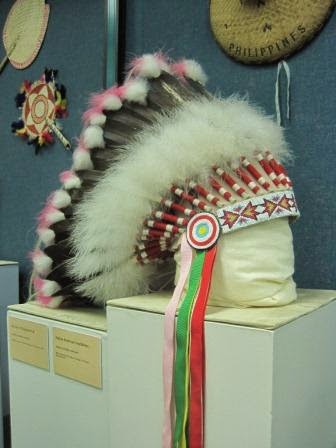
The first Rotorua Museum installation is based on the idea of travel. It includes a selection of souvenir items from other countries including a Native American headdress, a range of objects from the Pacific Islands and a curious Dutch clog lamp. The Museum will be doing three displays a year looking at different themes and subject matter.


Native American Headress

Dutch Clog Lamp