Showing posts with label Rotorua District Library. Show all posts

Friday, 1 February 2019

Te Aka Mauri Heritage Day


So today is Te Aka Mauri Heritage Day. One of the activities on offer today is “The Library that was” tour (11.30-12.30 and 2.30-3.30). We'd love you to come join in and see how things have changed. Maybe you can add your memories as we walk and talk.

Below is a brief history of the building know as Te Aka Mauri, Rotorua Library. We hope you come and make your own memories in this special place.

The former government building between Haupapa and Arawa Streets was renovated and opened to the public on 16 December 1991 as Rotorua Public Library.


In 2008/9 the library building was extensively renovated, adding 1000sq metres of floor space for the library.  A cafe was incorporated into the entrance design and an extra floor was opened up to accommodate the growing collections.  Three meeting rooms were created as well as a secure browsing area for some of the library's special heritage collections.  The entrance door was also moved to face out to Haupapa Street.  At that time, the library's name changed from Rotorua Public Library to Rotorua District Library.


In 2016 the library building was extensively renovated again in collaboration with the Lakes District Health Board which is what you see today.The aim is to provide a one-stop hub for children and their families with a range of services and amenities that contribute to well-being and learning.


Children's Area, Tiered Shelving (Front Entrance)

This was where the front entrance to the library was. On either side were stained glass artworks by local artist, John Skudder. The windows are now located on the 2nd floor outside the Don Stafford Room.


Jean Batten Park (Drive by Book Returns, driveway & parking)

On the eastern side of the building there used to be a driveway and parking which was installed in 1991. You could also return your books from your car using the drive through returns box which was installed in 2009.


Walk-bridge

There was an overhead walk-bridge here that linked the two buildings. This building (Te Aka Mauri) was where several Government departments were housed. The other building (Māori Land Court) was where the Māori Affairs Department was. The bridge was removed at the end of 1990, when construction on the library building began.


Community Meeting Room

The library’s mobile bus was housed here from 1991 to 2009. The space was also used by library staff to create and decorate floats for the Santa parades.  The space was then re-used as a café (Library Store Café) from April 2009 to April 2016 and had a beautiful mural by artist Mark Spijkerbosch.


Community Pride Wall and Magazine space

This space was used as the children’s area where activities were held and stories told from the carved wooden throne installed in 2010 and carved by Jamie Tereimana Tahiata. A fantasy mural by Marc Spijkerbosch used to cover this wall where the screens are. Local graffiti artist ‘Antz’ created a mural on the wall behind the fiction close to the men’s toilets of a taniwha.


1st floor non-fiction area 

This area was where the teens area was. Local graffiti artist Ant Haines created the ‘gurl’ and ‘boi’ murals on the walls by the windows.


1st floor non-fiction area

The adult non-fiction was arranged in Living Rooms, categories of books in similar fields, close to each other


Discovery Space

The archives, hidden from public view, were in the front corner of the now Discovery Space


What was the staff room is where the Heritage & Research Desk and computers now reside.We welcomed and said farewell to many staff and recognised each other’s achievements.
On this floor prior to the 2008, the 2nd floor was also used by Waiariki Polytechnic as teaching classrooms.


Don Stafford Room

This was part of our staff work space where our new library books were processed. It was also where we ran the library business from day-to-day.


The corridor beside the Reading Room 

The reading room was where the Don Stafford room was located. The space leading to the meeting rooms is where Information Services desk was located. The heritage collections stood where the Makerspace and iMac computer suite are.


Wishing Te Aka Mauri a wonderful 1st birthday.

This blog compiled by Trish. Many thanks to staff and ex-staff for photos and memories

Wednesday, 8 November 2017

Rotorua Library is moving forward

Rotorua Library, but first a look into the past. 

It all began in 1889 when a few like minded citizens decided the town needed a library.

ROTORUA PUBLIC LIBRARY AND READING ROOM AT OHINEMUTU

In March 1889 some 15 residents met in an old building next to Mrs Morrison’s Hotel at Ohinemutu to establish a Public Reading Room with home and colonial newspapers, periodicals, etc in which members could also play chess and draughts.
·        Committee of 12 was chosen with Dr Ginders elected as president. (see the document below) consisting of 3 Storekeepers, 2 Boarding House Proprietors, 1 Architect, 1 Saddler, 1 Surveyor, 1 Coach Driver, 1 Native Agent, 1 Teacher & 1 Carpenter.
·        Subscriptions were set at £1 per annum ($175) and visitors were to be allowed to use the Reading Room free of charge.
·        £25 ($4384) was donated by those present together with books and periodicals.
The Chairman of the Town Board lent the new library the use of the old building which had been first the Comet store and later a school. The District Superintendent of Native Schools let them use the desks and forms from the old schoolhouse and they obtained a kerosene lamp and a stove.


·        It opened to the public on 10 April 1889 with 335 volumes and 12 periodicals. A ladies’ reading room was also set up.
·        Hours were 11 am to 4 pm and 6-10 pm except that it would close at 9 pm on Sundays.
·        There was an honorary librarian, a Mr H. McFadgen (Saddler), but it probably wasn’t supervised as in December 1889 access was limited to subscription members only as many newspapers and periodicals had disappeared from the Reading Room.

 VICTORIA INSTITUTE was opened in November 1898
·        Miss Emma Coppell (or Coppel) was appointed caretaker and librarian at £10 per annum ($1571) Note this is £2 a year less than the cleaner was paid in 1890 and £5 less than the custodian in 1891
Description of Victoria Institute in about 1907
·        Set back from Arawa Street and next to the Maori Land Court.
·        The Library and museum was on one side of the building and on the other side was the Institute’s reception and cloakroom and an office for the Town Clerk.
·        The Library had about 1300 volumes at this time.

Municipal Building on corner Arawa and Fenton Streets 
·        New Library in Municipal Building was opened on 14 October 1940 though the children’s books were not shifted to the new library until February 1941.
The Library officially went free (except for light fiction and magazines) on the 17 February 1941 
·        Branch Library in Brookland Road, Western Heights opened on 12 May 1969. It closed in July 1981.

MASONIC BUILDING, FENTON STREET
In July 1970 the library moved for 6 months to temporary larger premises in the Masonic Building. It was there for 21 years.
·        Throughout the 1970s and 80s there was increased recognition that the Library was not adequate and needed expanding and upgrading.
·        February 1972 the NZ Library Association Conference was held in Rotorua (and 2001 and 2007).
·        1973 Miss Lesley Armstrong (Miss A) took over as Librarian.


Our 100 Year Celebration cake, enjoyed by staff & customers.

With thanks to the Don Stafford Collection and late staff member Mary Ellen Wilson, Reference Librarian, for the information and copy of the Library founding document. 

Tuesday, 9 August 2016

The new, temporary Rotorua Library.

Rotorua Library has a new location, 1238 Pukuatua Street.

From this 

To this
and this
Official opening ceremony 29 July 2016
Read all about our new space on the Rotorua Library website

Come and see us and enjoy our new 'Temporary Library' space at 1238 Pukuatua Street. We still have great books, magazines, DVD's and more available to borrow and free internet for all. Try the coffee at the Coffee Shack, ably provided by brother and sister team, Jason and Delina Dibben. 

We look forward to seeing you! 


Friday, 22 July 2016

Rotorua District Library is moving

A Brief History of the Rotorua Library

THE LIBRARY AT OHINEMUTU
21 March 1889
·        Some 15 residents met in an old building, firstly the Comet store and later a school, next to Mrs Morrison’s Hotel at Ohinemutu. They felt the need for a common meeting ground where they could exchange ideas without formality and it was proposed to establish a Public Reading Room.
·        Committee of 12 chosen with Dr Ginders elected as president and Mr J C Blythe as secretary (he was president later).
·        Name chosen: The Rotorua Public Library and Reading Room.
·        All visitors to the district allowed to use the Reading Room free of charge but according to rules and bylaws to be made.
·        A subscription list was opened and £25 ($4214.88) and donations of books and periodicals were given by those present

The Chairman of the Town Board (Dr Ginders) lent the new institution the use of the old building and the District Superintendent of Native Schools let them use the desks and forms from the old schoolhouse. A kerosene lamp and a stove were also obtained.

THE VICTORIA INSTITUTE
1898
·        Proposals were made to shift the present building from Ohinemutu to Arawa Street or to erect part of the new building. The second option was chosen.
·        Plans were submitted in May and it was nearly completed by October.
·        The AGM took place in the new Victoria Institute on 10 November and the reading room was opened to the public 9 days later.
·        Shelving from the old building was used for the lending section.
·        Miss Emma Coppell (or Coppel) was appointed caretaker and librarian at £10 per annum ($1545.45) Note this is £2 a year less than the cleaner was paid in 1890 and £5 less than the custodian in 1891 

Municipal Building on corner Arawa and Fenton Streets 
1940
·        New Library in Municipal Building was opened on 14 October 1940.
·        The Country Library Service also provided advice regarding layout, staff training, cataloguing and suggested changing the classification system from Bliss to Dewey.
·        The Library officially went free (except for light fiction and magazines) on the 17 February 1941 and Country Library Service provided staff to assist with the changeover and loans of books.
·        There was no policy for expansion for a children’s library – the books were still kept in the old building but were shifted to the new library in February 1941.

MASONIC BUILDING, FENTON STREET
·        Opened on 3 August 1970.
·        Throughout the 1970s and 80s there was increased recognition that the Library was not adequate and needed expanding and upgrading.
·        February 1972 the NZ Library Association Conference was held in Rotorua.
·        1973 Miss Lesley Armstrong took over as Librarian.
·        In January 1974 the Library was closed for a week while new carpet was laid. It was very hot and the workmen opened the front doors putting barriers across to keep the public out. Some people climbed over them.
When new carpet was laid in 2003 and 2004, the Library stayed open (except for the area being worked on) and much of the work was done at night.
·        New hours in January 1974 were 10am to 8pm Monday to Thursday and 10 to 8.30 on Friday.

HAUPAPA STREET (old Government building)
·        Officially opened by Governor General Dame Catherine Tizard on 16 December 1991 and opened to the public the following day.
·        Issues in the year following the move to the new building increased by 34%.
·        Lesley Armstrong retired as District Librarian after 21 years in December 1994 and was succeeded by Jane Gilbert (in January 1995).

Pukuatua Street (old Van Dyks)
2016
Opening at our new Temporary Location on 27th July 2016
Come and see it for yourself, you'll be amazed!

Sunday, 6 March 2016

Changing Face of Rotorua

Building Boom in Rotorua 


As recorded in the Rotorua Photo News by Michael Burton c1963-1967.

As I look around the Central Business District lately, I see lots of new buildings taking the place of old bungalow houses in Whakaue Street, 'new old' buildings in Pukaki Street and empty sections in Fenton Street. Having lived in Rotorua a looong time, seems like it anyway, these changes seem to be happening rather rapidly, but when I think back to my childhood and "the way we were" Rotorua has never stopped changing. So I thought I would share the following pictures from the Photo News to remind us that Rotorua has always been a forward thinking and vibrant city.

Just nearing completion, published in the Photo News Oct 23rd, 1965


The same Motel, January 2016.

Just before demolition starts, Photograph by Alison Leigh

New "Masonic Lodge" published in Photo News Oct 23rd, 1965
Almost the same view 1987, the Library was housed in this 'Temporary' location from c1972-1991

The 'New' sub-division of  Fenton Park In Apr 07, 1967 edition p91. Mr A. M. Linton presiding.

There are many more examples of 'new builds' throughout the Rotorua Photo News which can be viewed in the Don Stafford Room, 2nd Floor of the Rotorua District Library.


Wednesday, 1 July 2015

Matariki Flax Crafts

Matariki Kites

Kites were flown for recreation, but they also had other purposes. They were used for divination – to gauge whether an attack on an enemy stronghold would be successful, or to locate wrongdoers. They were also a means of communication. It is said that when the founding ancestor of Ngāti Porou, Porourangi, died in Whāngārā, on the East Coast, a kite was flown and his brother Tahu, the founding ancestor of Ngāi Tahu, was able to see it from the South Island. Sometimes people would release a kite and follow it, claiming and occupying the place where it landed.
Kites were flown to celebrate the start of the Māori New Year, when Matariki (the Pleiades) appeared in the mid-winter night sky.
Source : http://www.teara.govt.nz/en/kites-and-manu-tukutuku/page-1

To mark Matariki next week, Rotorua District Library, is having a Workshop and a Kite Flying event. Don't Miss Out.


Tuesday, 30 December 2014

Rotorua's First Ever Newspaper is now Online!


 Brief History :

Hot Lakes Chronicle - 9 Jun 1885-1916

The first district newspaper, founded by Theodore Lechner, printed in Rotorua. Publication was suspended in 1886, reappearing Sun 8 Oct 1887 under ownership of P A Crawford. Very few copies from this period exist. In Apr 1889 it became the Hot Lakes Weekly Chronicle, with 12 pages and more news. At this time it was being printed in Tauranga. Then from Jul 1889 was again called the Hot Lakes Chronicle, Published by Crawford who had offices at Ohinemutu and then in Arawa Street.
Proprietor and editor from 1895, F. F. Watt. Cyclopedia of New Zealand referred to it as “a first class weekly chronicle of all matters pertaining to the thermal district”. During the tourist season of 1901 it was published as a bi-weekly, on Wednesdays and Saturdays, but reverted to the Saturday issue for the winter months. Eight columns of reading matter, apart from advertisements.

This Newspaper is now available to read online via the National Library of NZs database, Papers Past.  A link to this wonderful resource is also available on the Rotorua District Library Online Catalogue.

 Article of Interest from 20 February 1895
On page 2 : “Protection of Trout” A meeting to consider the best means of preserving and protecting the trout in the various rivers in the district was held in the Palace Hotel on Friday evening, the 8th inst.

A list of attendees follows this and includes: J.H. Taylor voted to the chair, C. Malfroy Esq. J.P., Messrs Dansey, McRae, Warbrick, Webb, Carnachan, W. Kelly, M.H.R. Thom and others from Auckland.

“The Chairman said it was absolutely necessary for measures to be taken at once for the preservation and protection of the trout in their rivers and to arrange a constant supply of them from the hatching ponds. He had heard that the natives had been spearing and netting them and he had been told that even white people had threatened to dynamite them…”  The article goes on to document every word said, by every attendee and makes interesting reading for those interested in how this predecessor of modern conservation of trout in the district began.

 Here's what else was in the paper on 20 February 1895

 
Microfiche of this newspaper is also available to view on the 2nd Floor of the
Rotorua District Library. 
 
Dates available : 15 Feb 1895 - 20 Feb 1897, 4-5 Nov 1905
 
Other Newspapers also on Microfiche :
Rotorua Post 6 May 1948 - 1960 ; Rotorua Morning Post 24 Aug 1931—May 1948 ;

Rotorua Chronicle 10 Aug 1931 ; Daily Post 1961 to Present Day

Wednesday, 3 December 2014

Book Review : "The Ringers stand" by Godfrey Bowen


A Tribute to Godfrey Bowen, co-founder of the Agrodome, and brother of Ivan Bowen who pioneered the Bowen Technique still used by shearers today.


In 1982 he wrote a fictionalized account of Sheep Shearing competition “The Ringer’s stand” the book starts off with “Old Sam was a contractor of 30 years standing and he really knew his shearers. He had employed them all – good, average and indifferent – and occasionally the no-hoper” so begins the story of the Ringer.  The Ringer must prove himself worthy of his reputation and proceeds to do just that, and along the way sending the previous No.1 shearer back to No. 2 with some resentment but also grudging respect for the Ringer’s clearly the better, faster shearer.

Throughout the story some Shearing slang is used, these are just a few:

“Strangers” – the neighbours sheep with their owners earmark

“Fleeco” – Skilled shedhand who takes away the shorn fleece

“Wet ewes” – Ewes suckling a lamb

“Fadge” – An incomplete bale of unpressed fleeces, oddments or pieces

“Strides” – Shearers trousers

These slang terms give the reader a clear picture of the shearing shed and what is involved in shearing 800 sheep a day! Not a place for the unfit and fainthearted.

A copy of “The Ringer’s Stand” is held in the Don Stafford Room, Heritage Collection on the 2nd Floor.

Friday, 7 November 2014

Discover Your World with Rotorua Museum and Rotorua District Library

Rotorua Museum collections on display at the Library


1 November – 27 November 2014

As part of a new initiative Rotorua Museum Te Whare Taonga o Te Arawa will now be putting up small installations from its extensive collection at the Rotorua District Library.
 
The exhibits will be on show in the first floor display case in conjunction with the Library’s themed book selections which will change monthly.

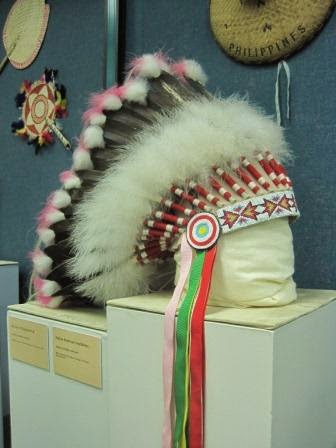
The first Rotorua Museum installation is based on the idea of travel. It includes a selection of souvenir items from other countries including a Native American headdress, a range of objects from the Pacific Islands and a curious Dutch clog lamp. The Museum will be doing three displays a year looking at different themes and subject matter.


Native American Headress

Dutch Clog Lamp

Tuesday, 4 November 2014

We will remember them


WW100: Commemorating the anniversary of WW1.


Excerpts from James Cowan's 'The Maori's in the Great War'


"In Rotorua there were scarcely any but older people, the women and children, every Arawa who could pass the doctor and look fit to carry a rifle and swag went into the camp to train for the great adventure. The age limit was liberally construed. There is a young Maori at Matata who enlisted with the Arawa in the 1st Maori Contingent, fought at Gallipoli in 1915 was invalided home where he married an Arawa girl and volunteered for further service abroad when his wife stopped his wandering by informing the authorities that he was only seventeen!"

"The Arawa and the Ngati Kahungunu of Te Wairoa were the first to volunteer to go to war for the British. They were organised into B Company and Platoon's 5 to 8 were shipped out to Auckland firstly on the troop-steamer 'Warrimoo' to Wellington where they took part in a Parade at Newtown Park before leaving for Gallipoli on 15 February 1915"

1st Contingent: B Company, Platoon 5 = Te Arawa; Platoon 6 = Te Awa-a-te-Atua to the East Coast and Waiapu ; Platoon 7 = Uawa (Tolaga Bay) and Gisborne ; Platoon 8 = Ngati Kahungunu from Te Mahia to Napier and Wairarapa.

The whole of the Maori contingents (1st and 2nd)then serving in Gallipoli were organised into the following platoon's and attached to NZ Infantry Brigades : Platoon's 1 & 2 - (Ngapuhi & Waikato) to the Auckland Battalion ; Platoon's 3 & 4 (West Coast of North Island, Wanganui & Wellington) to Wellington Battalion ; Platoon's 5 & 6 (Arawa, Bay of Plenty, Ngati Porou and East Coast, Taupo and South Island men) to Canterbury Battalion ; Platoon's 7 & 8 (Poverty Bay, Wairoa, Hawke's Bay and Wairarapa) to Otago Battalion.

By NZ Divisional Orders the formation of the NZ Pioneer Battalion was authorized on Feb 20th, 1916. The Battalion was to consist of officers and other ranks drawn from the N.Z.M.R.

"Captain Roger Dansey, whose dash has already been mentioned, himself killed three Turks with the bayonet. An anecdote of his alertness...was narrated by by one of his men long afterwards. "Captain Dansey", he said is as good a fighter as he was a footballer. Once a big Turk jumps up ahead of him he levels a rifle at his head. But Dansey just ducks and goes in for that Turk low down; the bullet goes over his head..."

Available to borrow, from the Maori Collection, on the 2nd Floor of Rotorua District Library. At 940.48z COW