Showing posts with label Donald M Stafford. Show all posts

Friday, 8 January 2021

Rotorua New Year's Eve Parade


Today the Rotorua Santa or Christmas Parade is a highlight of the festive season calendar leading up to Christmas. Originally the parade was held as part of a summer carnival in the New Year.

According to historian Don Stafford, a committee was formed in 1902 to plan a week long summer carnival to be held in 1903 to attraction tourists to the region. The event was held in late February 1903.

Unfortunately not many records remain of the early parades.

New Year Parade - Arawa Street, 1920, photographer unknown,
Rotorua Museum Te Whare Taonga o Te Arawa (2010.100.1254)


Government Tourist Bureau Decorated Float, 1937, photographer unknown,
Rotorua Museum Te Whare Taonga o Te Arawa (2010.100.1254)

The Carnival later grew to become the Christmas and New Year Carnival. The parade became the New Year's Eve Street Parade and was traditionally held in the afternoon of New Year's Eve. In the 1950s and 1960s a second parade was also held in the evening.

The programme also often included a Children's Fancy Dress Parade, which was held in the morning.

The New Year's Eve Parade was held for the last time on December 31, 1980, to end the year of the Centennial celebrations.

In 1981 the parade was held on December 19th and became the Santa or Christmas Parade that we know today.

Enjoy some memories of past New Year's Eve Parades. Thank you to the Rotorua Museum, Daily Post, and Don Stafford Collection for photos and information. This post was written by Graeme.

New Year Parade, 1957, photograph by Robert Crocker,
Rotorua Museum Te Whare Taonga o Te Arawa (2016.50.2)


New Year Parade, 1953, photograph unknown,
 Rotorua Museum Te Whare Taonga o Te Arawa (2010.100.1254)


Clown Float, Christmas/New Year Parade Rotorua, 1965, photograph by Gil Couper,
Rotorua Museum Te Whare Taonga o Te Arawa (2020.21.85)


New Year Parade, 1953, photograph supplied by Public Relations Office,
Rotorua Museum Te Whare Taonga o Te Arawa (Op-4374)


Centennial New Year Parade, 1980, photograph by Jack Lang,
Rotorua Museum Te Whare Taonga o Te Arawa (2020.23.81)


Friday, 6 November 2020

The Rotorua Township Agreement 1880-2020

1980 was a busy year for the City of Rotorua.

It was the year that the city chose to celebrate its founding on 25 November 1880. The year-long centennial celebration kicked off in style in November 1979 when the Morrison Quartet briefly reunited for a special concert at the Rotorua Civic Theatre. Rotorua District Council, local businesses and community groups sponsored and organised conferences, rallies, sporting events and cultural events. A logo was designed and used throughout the year on shirts, books, banners and rubbish bags. Special medallions were minted and a stamp launched.  Celebrations reached its climax in November 1980, with three major events which included a massive float parade that showcased the evolution of Rotorua; its environment, its people and various industries. Following this, three great waka landed in Ōhinemutu and were greeted by a 200 strong haka as well as hundreds of onlookers in the crowd. The year of celebration culminated with a re-enactment of the signing of the Rotorua Township Agreement, often called the Fenton Agreement. (Stafford, 1988, p. 390-391).


Chief Judge Francis Dart Fenton (or Penetana as he was known by Māori) of the Native Land Court is usually credited with establishing Rotorua township, however this was of course accomplished hand in hand with iwi. Fenton originally discussed the proposal with local iwi in 1877 and by direction of the Government he returned for detailed negotiations in 1880. From the Crown’s point of view, there were two main objectives behind the establishment of a township at Rotorua: preserve access to the natural thermal wonders of the district and to halt problems and arguments regarding land.

Francis Dart Fenton. Ref: PAColl-7489-01. Alexander Turnbull Library,
Wellington, New Zealand. 
/records/22424556

The proposed township would also have the added benefit of opening up the area to further settlement and improving accommodation, supplies and transport to the burgeoning tourist trade. Up until this time this was reliant upon a haphazard collection of European style hotels and shops that had developed in and around the old Ngāti Whakaue settlement of Ōhinemutu.

In late November 1880, negotiations were held over a number of days with Ngāti Whakaue, Ngāti Rangiwewehi and Ngāti Uenukukopako, ultimately culminating in the signing of the agreement document at Ōhinemutu on 25 November 1880 between 47 persons of the three iwi and Chief Judge Fenton on behalf of the Crown. Not all iwi were happy with this development being led by the three iwi, including Tūhourangi who claimed interests in the area proposed for the township.

Group of men, possibly at a Land Court meeting, inside Tamatekapua meeting house at Ohinemutu.
Ref: 1/2-043266-F. Alexander Turnbull Library, Wellington, New Zealand. 
/records/22557733

For the Māori owners, the proposed township would see an increase in visitors into the area, and a major source of income, without the need to permanently sell land.  As iwi at the time refused to sell land in the Lakes District to anyone, including the Crown, it was instead agreed that the Crown would lease lots in the township out to the public for 99 years on behalf of the owners. The agreement was split into 16 clauses which set out the area for the township, how ownership would be determined, reserves that were gifted by the owners to the Crown for both races, survey costs, rates and composition of the town board.

Up until the Agreement, iwi had refused to allow the Native Land Court sit in the district knowing that to do so would likely result in the eventual loss of land through sale. However Fenton convinced iwi that for the township scheme to be successful the Court would need to decide the ownership of the township land. Following a protracted Court hearing, the Native Land Court awarded the majority of the town block, taking in the area between the Utuhina and Puarenga Streams from the lake front to Tihiotonga and called Pukeroa-Oruawhata, to Ngāti Whakaue with a section of the block called Tarewa being awarded to Ngāti Tuara and Ngāti Kearoa. This award had a number of consequences. It excluded Ngāti Rangiwewehi and Ngāti Uenukukopako from participating further in the township scheme and it saw iwi resistance to the Native Land Court in the Lakes District erode as a cascade of land claims to other land blocks were received by the Court.


While the township scheme was widely publicised, and initially successful in attracting leasees, the delay in the establishment of the promised railway, a national economic downturn, the Tarawera eruption in 1886 and a string of defaulting leasees all contributed to an enormous loss in expected revenue. 

Starting in 1889, the Crown sought to purchase shares from owners in the block. The Crown and the Ngāti Whakaue were co-owners in the Pukeroa-Oruawhata Block at the time. The alienation of the block from the last few owners, and vesting of the township block (Pukeroa-Oruawhata Block) in the Crown, was completed through the compulsorily acquirement of shares via the Thermal Springs Act of 1910. The Crown later sold these interests between 1930 and 1950, opening up the township lands to private ownership. Over the next few decades, Over the next few decades, Ngāti Whakaue sought answers from the Crown over the failure of the township scheme and care of the gifted reserves (Rose, 2004).

Meanwhile the Agreement had established the first governing body of the Rotorua Township, being the Rotorua Town Board, which was originally made up of the local Doctor, resident magistrate and a Ngāti Whakaue representative, all appointed by Central Government.

The Rotorua Town Board first meet in April 1883 however besides the administration of certain government services and hotel license fees, the Board was restricted on what it could do and achieve. Hamuera Pango, who died in 1893, was the last Ngāti Whakaue representative on the board.

Source: The Founding Years in Rotorua by D.M.Stafford

The Rotorua Town Council Act was passed in 1900 which altered the constitution of the Rotorua Town Board so that it became a Council with a membership of seven; three locally elected representatives with the other four being appointed by Central Government.

The Town Board was disestablished in 1907 at which point the Tourist Department took over the administration of the township. The Rotorua Borough Council was established by the Rotorua Town Lands Act 1920, and the first election was undertaken in 1923 although Central Government would still appoint two of the seven positions. In fact, it would not be until 1950 that a mayor and Council would take office without Central Government appointees.

The Rotorua Borough Council became the Rotorua City Council upon Rotorua achieving City status in 1962. The Rotorua City Council and the Rotorua County Council amalgamated in 1979 to form the Rotorua District Council.

In late November 1980, Ngāti Whakaue hosted all of Rotorua and Te Arawa at Te Papaiouru Marae for the re-enactment of the Fenton Agreement signing. 400 members of Te Arawa gathered on the steps of Tamatekapua Meeting House, they sung and chanted as Judge Fenton (Played by Mervyn Julian) and his interpreter (played by Sam Gardiner)emerged from St Faiths Church dressed in period costume. They crossed over to a table set up in front of Tamatekapua where the descendants of the original land owners again placed their signatures. As was befitting such an occasion, amongst the many official guests in attendance was Tennant Fenton, grandson of Chief Judge Fenton.

Rotorua Centennial Celebrations. 1980. Photograph by Jack Lang (1915 – 1986).
Rotorua Museum Te Whare Taonga o Te Arawa (CP-2868)

It is interesting to remember that our city’s foundation was built upon a unique relationship between the Crown and local tāngata whenua. The Rotorua Township Agreement should be remembered as being an integral part of our shared, communal history as a city, an example of great generosity by iwi and a forward thinking willingness to work together. Rotorua’s 130 year anniversary passed quietly and largely unnoticed, with Rotorua perhaps still mourning the loss of local historian Don Stafford.

Let us hope then that Rotorua 2020 is a little different, that we will choose to remember, discuss, debate, commiserate, celebrate and reflect on our Cities past 140 years; the good, the bad, and everything in-between.

B T Manley 
Pūkenga Rangahau, Rotorua Lakes Council

References

Rose, K. (2004). The Fenton Agreement and Land Alienation in the Rotorua District in the Nineteenth Century. Wellington: Crown Forestry Rental Trust.

Stafford, Donald Murray. (1988). The New Century in Rotorua. Rotorua: Rotorua District Council.


Friday, 29 November 2019

Book reviews - celebrating Rotorua's history

This week we review some gems in our collection, which celebrate Rotorua's history and people.

100 years of Rotorua / by Ian Rockel

This book was published in 1979 by then Rotorua Museum director Ian Rockel, ahead of the 1980 Rotorua Centenary.

Rockel divides the book into sections looking at various aspects of Rotorua's history including growth, tourism, industry, forestry, people, construction, transport, government, farming, church, and the district's founding settlers.

The book also features over 150 photographs illustrating the history of Rotorua's first 100 years.


This book can be found on the 1st Floor,
NZ History / Travel and 2nd Floor Rotorua Heritage at 993.423Z ONE

This book review was written by Graeme


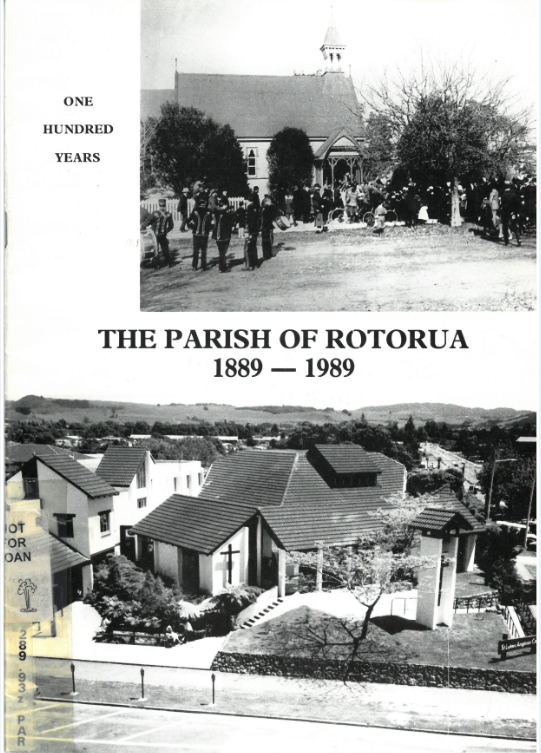
The Parish of Rotorua, 1889-1989: 100 years by St Luke's Church, Rotorua

This book was published to celebrate 100 years of St Luke's Anglican Church in Rotorua. The cover shows the original St Luke's (circa. 1905) and the replacement St Luke's which opened in 1975.

Beginning with  a brief history of early missionaries in Rotorua, the book then contains snapshots of events and meeting minutes, celebrating the years. Photographs illustrate throughout.

Features of the "new" church are described, along with a list of the vicars who had served over the 100 years.

The book concludes with a look to the future, and the centennial programme for the for the week long celebrations.

This book can be found on the 2nd Floor, in the Don Stafford Room
 in the Rotorua Heritage Collection at 289.93 PAR


This book review was written by Trish


City of Rotorua Museum and Arts Centre / published by Rotorua City Council c.1969?

This booklet was published to showcase the new museum which opened officially on the 1st November 1969.

Their aims for this museum were ‘to reflect the background and perhaps foretell the future of this vibrant district’

‘It has been established and is supported entirely by the Rotorua City Council in the belief that such an institution is a pre-requisite to the cultural maturity of a growing city’

The booklet shows the grandeur of the Bath House in black & white photographs and describes the very first exhibitions.  At this time the Art Gallery was in a small corner of the museum and was managed by the Rotorua Society of Arts.

Don Stafford, here pictured as curator of the Museum : With thanks to the Daily Post
for this article published in 'Picture Post' July 1969 pg. 15

The Government Gardens / Philip Andrews c2005

This colourful and informative book was written by local historian Mr Phil Andrews. His introduction sets the scene with this description of the land before it became the Government Gardens that we know and love today.  It was described as “dreary, swampy, scrubby place… a howling wilderness”

The Fenton Agreement which was signed in 1880 was debated and negotiated between the Te Komiti Nui o Rotorua (The Great Committee) and Judge Fenton on behalf of the government of the day. 

Phil gives us a readable history of each of the many features and buildings of the gardens and throughout this book there are photographs of what it once was and how it was in c2005 as photographed mostly by John Wheadon. 

The older photographs and postcards were supplied from various sources as noted with each image.  Phil includes aerial photographs which show the location of each historical feature in the gardens and also the wider Sanatorium Reserve Sites.

A number of the features, buildings and memorials have been restored to their original pristine state, with the Bath House still awaiting earthquake strengthening and upgrade of the buildings most historic features. 

Photo by Alison Leigh 2013

These book reviews written by Alison

The Pride of a Century: the Daily Post centennial issue, August 28, 1980

Stories are amazing and can instil in the listener or reader a sense of tradition and history. For this writer, my imagination was stimulated. I was able to see through the lens of story-telling the pride that local people have in their place, their town, their city. The issue is more the development of a township with its history of tourism and unique thermal attractions. The stories reflect a sense of pride in the people and events that shaped this place, Rotorua. Some highlights include a historical timeline spanning 630 years from the discoveries of Ihenga to the amalgamated local government body, The Rotorua District Council. One of my favourites I have to stay are the stories of the development of transport from the horse drawn to horse powered. There was one advertisement that brought back memories of the 80s and the 'big hair' fashion trend. Thank you to the "Hair Shop and Rodneys Hairdressing Salons".

Features of the issue:

  • Thermal nurseries - garden centre
  • Two Miss New Zealand's - Maureen Waaka 1962, Linda Ritchie 1971
  • The creation of the township of Rotorua and local government
  • Memories of how the town has changed through the eyese of local people
  • Notable people in Rotorua's history: Rotohiko Haupapa, Guide Rangi, Roger Dansey
  • Advertisements such as, "Aunt Janet's Prize Baking Flour"
  • The land wars
  • The growth at Ohinemutu
  • Introducing electricity
  • Congratulations from local businesses
  • Te Arawa Maori Trust Board created as a result of the Tamihana Korokai vs The Solicitor General case
  • Sports
  • One of Rotorua's oldest drapery firms, The Gardner Group
  • Tourism - unique thermal attractions i.e. pink & white terraces, thermal pools, geysers
  • Mokoia Island history
  • Whakarewarewa
  • Transport
  • The eruption
  • The world wars
  • Services - police
  • My favourite - The Hair Shop and Rodneys Hairdressing Salons

Advertisement, The Hair Shop and Rodneys

This centennial issue of The Daily Post can be found in
 the Don Stafford Room at 993.423Z PRI OVERSIZE


The book review was written by Ani

Friday, 11 October 2019

Rotorua Mile Stones & random news events recorded in Rotorua and other NZ Newspapers c1889-1980.

Rotorua as seen in the News

October 1889 & 1890 Bay of Plenty Times (BPT)

Local talks and negotiations with Government continue as they seek to purchase the new Town.  See the Fenton Agreement.

BPT 12 October 1891: The Town Board offers a £5 reward for information on the person or persons who destroyed recently planted willow trees on the Esplanade.

BPT 26 Oct 1891: Many applications are being received for business and residential sections in the new Town. Minister of Lands assures them he will arrange matters to the gratification of the applicants.

BPT 26 Oct 1894: An Auckland builder W.H. Holman’s tender to build the Rotorua Court House is accepted.

Hot Lakes Chronicle 2 October 1895 : 
 ‘The Town Board calls for tenders for the formation of Pukuatua & Hinemoa Streets between Fenton and Tutanekai Streets, and for grubbing the extension of Hinemoa Street’

 ‘Town Board has estimated that the cost of water pipes to be extended along Tutanekai and various cross-streets would cost £972 and a further sum of £500 would be required to extend the Postmaster’s Bath’

‘Stray cattle & horses might still be seen at large about the streets, in spite of the ‘stringent’ instructions to the Poundkeeper. He recently manifested his zeal in impounding the [Town Board] chairman and secretary’s horses and it was gratifying to see that he showed not fear nor favour’

‘Mr Dansey proposed a ‘Fire Brigade’ for the town and asks for funding from the Town Board. The Chairman, Mr Malfroy, said “that in the meantime it was only a moral support that could be given, but he believed that in a measure now before the House [Parliament], power would be given whereby the Board could aid them financially.”   Mr Corlett one of a deputation for the Fire Brigade, stated that some work had already begun to form a Brigade and would like assistance from the Board in “obtaining a site for a fire station in the new town” in the conversation that ensued, it was suggested that there would be plenty of room in the Courthouse enclosure and it was not likely that the Dept. of Justice would make any objection’ [This did eventually occur in c1905 after the Grand Hotel burned to the ground on October 24th 1904] 

Fire brigade outside station, Haupapa Street, Rotorua; Circa 1921; OP-864
Owner of Photograph : Rotorua Museum 


Hot Lakes Chronicle 7 Oct 1896 the Local news includes the following:

‘The Native Land Court has been engaged during the week in dealing with succession orders, and the partition of the Paeroa Block, Waiotapu. The Horohoro cases will be taken on the 15th.’

‘The Whakatane-Te Teko road is now advanced to within five miles of the Tarawera River. The construction party is now working about two miles to the westward of Rotorua and Rotoiti-paku, between which lakes the road will pass’

‘The highly mineralised atmosphere in this locality has a most deleterious effect on the delicate mechanism of watches and enquiries are frequently made as to which watch is best adapted to withstand the sulphur fumes. Mr Kohn a watchmaker of Auckland… supplies a particular make of stem-winding watches… which are warrented impervious to the influences in question’   

‘The Prospecting Association held a meeting to receive reports from the prospectors who have been at work at Horohoro and in the neighbourhood of Tapuaeharuru on Lake Rotoiti. In regard to the former a Mr Macdonald stated that he had found nothing which would indicate the presence of gold.’

‘A highly successful tea and social took place in the Schoolhouse on Wednesday evening last in aid of the funds for the erection of the Presbyterian church’

In the Hot Lakes Chronicle 21 Oct 1896 an article appeared on ‘Work at Whakarewarewa’

The Geyser Area at Whakarewarewa as surveyed by Mr Baber, work had already begun and further work planned to open up the area by road and footpaths. The article mentions a rickety bridge by which access is currently gained to the area and it was expected that a new bridge, ‘strong and wide enough for vehicular traffic’ would be built. The article goes on to say ‘In regard to Pohutu, Mr Malfroy informed us [the people in this entourage] that he intends to do something which will cause it to play regularly every day at a certain hour.’

In the Hot Lakes Chronicle 28th October 1896 a report was published outlining the Library and Reading Room Annual Report.

One of the income items was listed as ‘Sales of Waste Paper’ and they received a sum of £1 and 8 pence.

The listed expenses included Newspapers, Magazines, Kerosene, Insurance, concerts expenses, coal, solicitor’s fee’s and stamps. This all came to the grand sum of £59.  The Library and Reading Room at this time was in a small building next to the Comet Store, as seen in a photo published in our October 2018 blog post.


Auckland Star 3 October 1912: Lands for selection ‘Certain areas of town and village will be offered for sale or lease by public auction by the Crown Lands Department at the Assembly Hall…the greater portion of the land is situated in the town and suburbs of Rotorua.’

Lyttelton Times 7 November 1914: Rotorua Tenures Commission formed. “It has been ascertained that under the ‘Thermal Springs Act, 1881 there were 386 leases’ a further 429 leases were issued under subsequent acts in 1892 and 1908… the ‘Commissioners are of the opinion that it would be in the interests of  the State that any holder of leasehold Crown lands other than the occupiers of the Education Reserve desiring to obtain freehold should be afforded the opportunity’

Rotorua Chronicle 9th October 1920: Rotorua Town Lands Act is passed. 

Evening Star 31st October 1922: Rotorua Borough Act is passed, this enables the first Councillors and Mayor of Rotorua to be elected. This also is when the Tourist Department ceases to administer the affairs of the town.

Rotorua Morning Post 14th October 1937: The First State Houses are built (next to Council Housing Project)

Rotorua Morning Post 14th October 1940: The new Library was officially opened (in the Municipal Building)

Rotorua Morning Post 5th October 1942 : The avenue of Gum trees lining both sides of Fenton Street are to be felled because the Electricity Dept. says they are too tall and are encroaching on the lines.

Rotorua Morning Post 29th October 1945: The Dedication of the Bell Shrine at Ohinemutu takes place. This is a memorial to Mr Tai Mitchell.

Rotorua Post 11th October 1955: Mr Ed Hillary is in town to raise funds for his NZ Team to Antarctica.

Rotorua Post 13th October 1956: The Rotorua branch of the National Council of Women is inaugurated.

Daily Post 3rd October 1964: The new Rotorua Airport is officially opened.

Daily Post 14th October 1966: The premier of Howard Morrison’s film “Don’t let it get to you” is shown.

Daily Post 4th October 1967: Alfred Hitchcock visits Rotorua.

Daily Post 13th October 1969: The new Kiwanis Club receives their Charter.

Daily Post 6th October 1971: The Rotorua Association of Paraplegic and Disabled Persons is formed.

Daily Post 15th October 1973: The Rotorua Supreme Court is officially opened by the Chief Justice of New Zealand Sir Richard Wild.

Daily Post 3rd October 1978: The Citizen’s Advice Bureau officially opens in Arawa Street, with a trained volunteer staff of 44. They will be open 6 days a week.


Daily Post 1st October 1980: The Ritz Hall on the Cnr of Fenton & Amohau Streets is demolished.

This Blog Post by Alison with thanks to Papers Past for access to the online copies of the Hot Lakes Chronicle and other New Zealand Newspapers, Rotorua Museum and the Rotorua Library Don Stafford Collection.

Friday, 14 June 2019

The Winter Show : Rotorua Agricultural & Pastoral Association


 The A&P Winter Show c.1923-c.1966

The first Rotorua Winter Show is recorded as being in 1923 just before the successful Auckland Winter Show, and was modeled on the 1922 Auckland Show. 

In 1927 the Summer Show was dropped in favour of the Winter Show as this was more popular. The winter shows were held in a garage owned by the Rotorua Motor Transport Co.

The Ritz Hall built c.1935 for the A&P Shows was rented out in between shows.

The Ritz was taken over by the RNZAF in 1942 as a training venue (and for dances) and handed back to the Association in 1946, and the Association ran its Winter Show again for the first time since 1941.

c.1930’s the Association bought a section of some 30 acres on Old Taupo Road which ran between Uta Street and the Utuhina Stream. 

At some point prior to the 1962 document shown here, the Summer Show’s began again.

Unfortunately on New Year’s Eve of 1962 a fire destroyed the main hall of the ‘Ritz’. The Associations insurance company was quick to pay out and the hall was rebuilt with improvements and a geothermal bore was installed to supply hot water, but the heating component for the hall was delayed until funding could be found. The heating was installed in c1963 to the three halls owned by the Association.  In 1964 there was some discussion around the revenue from the rental of each hall as the Association required the use of all venues for the Winter Show and the annual one day Summer Show. 

Rotorua A&P Association Inc. Annual Report for the year ended 31 Dec 1962

By 1964 the Rotorua Photo News had begun publishing photos from the Winter Shows. As seen below the show included a range of events not seen today. 

Rotorua Photo News 1 Aug 1964 pg 30

A Beatles Impersonation Competition proved very popular...

Rotorua Photo News 1 Aug 1964 pg's 31-32

The Winter Show was held again in 1965, 1966 and 1969. Beyond 1969, the winter show no longer features as an event in the annual reports of the Association.  As shown below there was some concern about the financial state of the Association in 1966. The Association took possession of a new property at Ngongotaha on the 1st June 1968 and the 1969 Summer Show was held there with much success.  This property was called Riverdale Park and a portion of this park is still in use today for the A&P Shows every Auckland Anniversary weekend. The Ritz Hall was sold in 1980.


A programme that was printed by Rotorua A&P Assoc. 
This Post was written by Alison, with thanks to the Don Stafford Collection and Norma Evans collection and Rotorua Photo News held by the Library.


Wednesday, 22 August 2018

Church Time Line Rotorua 1831-1981

Rotorua Churches 1831-1981

  • Missionaries 1831-1880
  • Te Koutu Mission Station c.1835. Anglican/CofE
    • Mokoia Island Mission Station c.1838. Anglican/CofE
    • Te Ngae Mission Station c.1843 Anglican/CofE
    • Te Mu c.1845-1861– Anglican/Church of England.
  • St Joachim c.1847 - Roman Catholic, Pukeroa Hill
  • Te Mapou, Tapuaekura  (Lake Rotoiti) c.1850-
  • St Faith’s c.1880 – Anglican, Muruika Peninsula
  • Baptist Mission, Te Wairoa 1882-1886
  • St Michael’s c.1890 – Roman Catholic, Ohinemutu /St Michael's – new church built around old one Feb 1964- see Photo News 15 Feb 1964 pg. 3
    • New school built behind Convent c.1903. 
  • Salvation Army c.1891-1955 – Arawa Street approx.  80 Arawa Street  (becomes new Palace Tavern c.1966)
      • Red Shield Hut c.1914-1943, Soldier’s Institute – Arawa Street, possibly 81 or 83 (new McGill’s 1954)
      • Salvation Army c.1956 - 271 Old Taupo Road
      • New Citadel 1987 a Lockwood Building at 271 Old Taupo Road.
  • St Joseph’s c.1892 – Near Taheke
  • St John’s c.1896-1988 – Pukuatua Street, Presbyterian 
      • Trinity Presbyterian Church c.1901– current at Mamaku 
      • Trinity Presbyterian Church c 1950 – 13 School Rd, Ngongotaha.
      • St John’s in the City – c.1989-2017 Cnr. Ranolf & Victoria Streets 
      • St John’s on Fenton c.2017- at 276 Fenton Street (to be rebuilt Cnr. Ranolf & Victoria)
  • St Luke’s c.1899-1973 – Haupapa Street, Anglican
      • St Luke’s c.1975-Present – Cnr Pukuatua & Amohia Streets
      • St Andrew’s-St David’s Presbyterian, c.1958-c.2014. Cnr Devon and Old Taupo Rd.
      • Also known as St Andrew’s on the Roundabout.
  • St Mary of the Cross c.1904 – Whakarewarewa, Anglican. – Renamed Te Arawa Church.
    • Church of the Immaculate Conception c.1904 – Whakarewarewa, Roman Catholic.
  • Bainbridge Memorial Church c.1906-1982 Hinemoa Street, United Methodist.
      • Bainbridge Methodist Church c.1986- Old Taupo Road
      • Methodist at Mamaku,  see c.1908.
    • St Joseph’s at Owhata (Roman Catholic Church) c.1907, and St Joseph’s at Mamaku.
    • Father Kreymbourg built these two churches himself.
      • St Michael’s at Mamaku c.1912, 1925. St Joseph’s (1933-1986) The Catholic Church at Mamaku is blown off its piles in a severe storm. DP 11.7. 1986.
  • Methodist Church at Mamaku c.1908- Mr Souster and his brother-in-law build the first.
  • St Peter’s on the Rock c.1911-2017 – Mamaku, Anglican.
  • Church of the Immaculate Conception.  c.1915–c.2012. 27 Taui St, Ngongotaha.  Used by Oasis Church c.2008-2012. Church demolished c2013.
  • St Barnabas c 1924– (16 School Road) Ngongotaha [initially used by all denominations needing a church hall in Ngongotaha.]
  • Chapel of Ease c.1926-c.1959? At the St Joseph’s Convent – Ranolf Street
      • See St Mary’s Church 1954.
      • New Convent on Carnot Street opened 1959.
  • Devon Street Hall – c.1928- Cnr. Fenton & Devon Streets – Church of England
      • St Chad’s (c.1982-Present.  St Chad’s Charitable Trust.)
St Chad's c.1920's  Cnr. Devon and Fenton Streets.
Sir George Grey Special Collections, Auckland Libraries, 4-6217' 
  • St Peter’s c.1933 - Owhata Marae, Anglican
  • Bethesda Chapel c.1934-1955 – 36 Eruera Street, Brethren
      • Ranolf Street Gospel Chapel, c.1957-1970 – Ranolf Street.
      • Fenton Park Gospel Chapel, c. 1970- Cnr Ward & Hilda Streets. [Fenton Park Bible Church]
      • Roosevelt Road Gospel Chapel – c.1969 - 5 Roosevelt Road, Western Heights.
      • See New Heights c.2005-2007. Reverts to Roosevelt Rd Bible Church.
      • Mamaku Brethren c.1960's-2008/09?
Fenton Park Gospel Chapel in construction
Rotorua Photonews 9 May 1970 pg.2

  • St Paul’s c.1935 – 28 Church Road, Ngapuna. (Anglican) Consecrated by Bishop of Aotearoa 30th June 1935.
  • Baptist c.1939 – a visiting Minister from Putaruru came to Rotorua to hold services until…
      • 1st Church, officially opened c.1945 – 100 Malfroy Road.
      • Baptist (new church) next to old one, opened 9.2.1978 see Daily Post for story.
  • Church of Latter Day Saints (Mormon) c.1930's – New church opened c.1960 - 10 Rimu Street.
  • St Mary’s Catholic Church, 1954-1984 - Ranolf Street.
    • New Church plans, for a new building/renovation of the 1954 church in 1984.
  • St Mary’s Anglican Church, c.1954 at Horohoro Marae.  Either Kearoa or Rongomaipapa
  • Kingdom Hall c.1956-2004–Jehovah’s Witness – 303 Fenton Street.
    • Kawaha Point Kingdom Hall 1995-
    • Ngongotaha Congregation c1990-
    • c.2004- Kingdom Hall – moved out of Fenton street to new church 250 Vaughan Road.

  • St Columba Presbyterian Hall, c.1958-c.1993 at 155-157 Clayton Road. [A church was to be moved here from Tauranga in 1982.]
  • Wesleyan Methodist Church c. 1959-1980. At 219 Clayton Road [church used by other denominations since 1980]
  • Methodist Church – 1962 - Ngongotaha (see also previous one at Mamaku 1939) 
  • The Apostolic Church : (also known as Bethel Temple) – c.1961-1984. 70 Malfroy Road (included Bible College c.1966)
    • Rotorua Apostolic Life Centre 1984-c.1995: 1 Maisey Place
    • 46 Hinemoa Street  c.1996 - Cnr Tutanekai & Pukaki Streets c.1998 - Lake City Church 
    • Destiny c.2005-
  • Christian Science Society c.1961 – does not have own building until c.1972-1977. Cnr Old Taupo Rd and Konene Street.
  • St David’s Presbyterian c.1963-current at Reeve Road, Owhata.
  • St Francis Church c.1963-1970's is used by Western Heights Play Centre 1970's, 13 Thomas Crescent (Anglican)
    • St Francis Whanau Aroha Day Care.  c.2000-current at 13 Thomas Crescent.   
  • All Saints Hall c1963–sold-c2017. 223 Malfroy Road, Anglican. [also used by other denominations for church services.]
  • Lutheran Church c.1967–c1999 89 Sunset Road [now a Daycare Centre]
  • Church of the Good Shepherd c1970– Awahou – non denominational - Ngati Rangiwewehi Marae.
  • Seventh - day Adventist c.1950- 6 Tilsley Street – school opens 1965.
    • Seventh - day Adventist, c.1970-current. (New church) 311 Fenton Street.
    • Samoan-Tokelauan Seventh-day Adventist c.2016-current, 274 Old Taupo Rd
    • Maranatha Seventh - day Adventist c2014-current, in Old St Andrews Church, Old Taupo Road
  • Baha’i Faith - c.1975-c.1979, 1984-current.  
  • Assembly of God, c.1972-1992 – 14 Gibson Street, Fenton Park.
    • Assembly of God c.1986-current at 20-40 Biak Street 
    • Samoan Independent Assembly of God. c.1977–2006.  274 Old Taupo Road.
  • St Paul’s c.1975 – Ngakuru (was St Bride’s from Auckland) Presbyterian - becomes Christ’s Church (shared between Anglican, Roman Catholic and Presbyterian congregations). Services were held in the School Hall c.1927 and 1950's.
  • Bible Baptist Church.  c.1978-current 55-71 Pukehangi Rd. [Church built c.1980's]

With thanks to the Don Stafford Collection, Papers Past and Rotorua Library Photonews collection, Who's Who in Rotorua and Rotorua Phone Directory collections.

Thursday, 28 December 2017

Rotorua: Summer of STEAM : Biking and Cycling of Times Past

Cycling in Rotorua c.1898 & Today

THEN
Rotorua has long been a mecca for the keen cyclist, as early as 1898 Rotorua had a Cyclist's Club and in 1899 a Lady Cyclist's Club.

The following is an excerpt from a news article entitled "An ungallant Town Board" :

"in Strictly reserving the footpaths of the Town to pedestrians ...these callous Boardmen would not listen to the voice of the charmer (who in this case was the Hon. Secretary of the Lady Cyclists Club) charmed she ever so wisely, but turned a deaf ear to all her supplications...the letter placed before the board asked on behalf of lady bikists that they should reconsider it's decision...and allow the fairer sex to use same" As reported in the Thames Star of 8 April 1899. Click here to read the Full Article

The following rendition of a Lady Cyclist is from 1897 and was published in the Christchurch Star.
Papers Past : Advertisements, Column 2, Star, Issue 5793, 10 February 1897

In 1898 the Bellvue House on Fenton Street, advertised their location to be most suitable for cyclists.

With thanks to Papers Past for this advertisement.
New Zealand Herald, 5 November 1898.
The advertisement does not make mention of the condition of the roads in the town however!  These were in construction from c.1890 and the Town Board had also "resolved that notice board printed on calico be erected , warning in English and Maori against 'leading, riding or driving horses, or any animal, along the footpaths. The police were to be asked to prosecute anyone infringing this by-law.' in Gold and geysers by Phil Andrews p.85

"In February 1898 an epic decision was made by the Town Board to lay down bicycle tracks beside the footpaths - the first such scheme in NZ." in The Founding Years by Don Stafford p.317.


NOW
Today in Rotorua we have a similar situation with bicycle paths, some of which are shared with pedestrians on the CyWay.


Tuesday, 29 August 2017

Family in the News : a Family History Tip

Rotorua People in the newspaper

Did you know your family member was in the news? Have you thought of looking through Don Stafford's Research Folders for your family member?

At Rotorua Library we are blessed to have in our collection Don's research folders, which include 8 volumes of biographical information about Rotorua residents of the past up to the late 1980,s when Don published his 2 volume history of Rotorua.   The library also has Don's card index of Rotorua people.  

In Don's Sports Folder we find his research of the Bay of Plenty Times and Rotorua newspapers this shows the earliest events to be Horse Racing (1872) and the Rotorua Jockey Club being in existence in 1881.  The list of names as noted by Don are the following : President William Kelly; Judge Henry W. Mitchell; Starter Capt. H. Way; Clerk of the Course J.L.R. Fraser; Clerk of the Scales James Stanley Esq. ; Handicapper Joseph Ellis Esq.; Treasurer J. H. Taylor Esq. and Stewards Messrs J. Kelly, R.D. Dansey, J.H. Taylor, B.F.J Edwards, J.D. Wrigley, C. Hetley, T.J. Bennett, J. McRae, W.A. Thom, J.C. Young, W.Harvey, Wi Maihi and W.A. Ellis.

Perhaps one of the men above is your ancestor, did you know they were so involved in the races?


Another well reported event was the Annual Regatta which needed funds raised and therefore the following committee was formed : President - Mr Robert Graham, Vice President Mr William Kelly and Secretary Mr W.A. Ellis.

Rotorua Regatta as reported in the Bay of Plenty Times 19 Apr 1881
excerpt courtesy of Papers Past
What else might your ancestor have been involved in? 

Rotorua Library is also blessed with another historian by the name of Phil Andrews who has written several books, these being :
Ngongotaha's Story ; Ko Mata : the life of Anne Chapman ; No fear of rusting : a biography of Rev. Thomas Chapman ; Gold & geysers ; Women in Wonderland ; Mokoia: a brief history ; Stones bones steam ; Government Gardens : a walk through history ; Rotorua Streets: the story behind the street names... and Tarawera and the Terraces.

Phil also had a column in the Rotorua Daily Post where he wrote a lot of Rotorua stories.

These are just two authors and history enthusiasts who have put together books that showcase Rotorua past, the past is why Rotorua has grown the way it has and will continue into the future : Community involvement at it's heart.

Build a picture, of where You came from, using either Don's or Phil's well researched publications held in the Heritage & Research area of Rotorua Library.


Wednesday, 17 May 2017

Careers and Education in Rotorua : Past and Present

Careers in a bygone era

These days a career must have an IT component to it, and the student must have a computer or device like iPad Pro.  Just think what changes there have been since 1886 (post Mt Tarawera eruption).

In the 1885/86 Electoral Roll the careers/occupations for Rotorua were : Bakers (6), Bootmaker (1), Builder (1), Butcher (2), Carpenter (12), Coach Proprietor (1), Coach Driver (4), Dentist (1), Farmer (3), Groom (7), Physician (1), Postmaster (1), Resident Medical Officer (1), Stable Owner (1), Surveyor (4), Veterinarian (1), Barman (2), Bath Attendant (1), Clerk (1), Contractor (1), Gardener (1), Native Agent (2), Native Interpreter (2), Overseer (1), Publican (1), Sawyer (7), Storekeeper (9) and Waiter (2).

Don Stafford's "Founding Years of Rotorua" tells us that the population at that time was approximately 453 Europeans and 1,375 Maori. By 1901 the population of Europeans had jumped to 1,278 and an estimate of 930 Maori.

In 1901 the occupations listed included an Architect, a Station Master, a Cordial Maker, a Tobacconist, 7 Engineers, 2 Police Constables, 3 Photographers, 3 Laundresses, 13 Storekeepers , 2 Fruiterers, 2 Mill Owners and 7 Domestic Servants, to name a few.

Sulphur Mining was a booming industry from 1889 with Rotorua's biggest dealer being Mr Francis Moss (Mossy) Boord and it provided an income for local Maori landowners around the region.

Also at this time the Okere Falls Power Station was built and also Gold Mining occurred around Horo Horo and Kaharoa, but this was a short lived occupation as little gold was found and other rumored finds in the region were unsubstantiated.

One of the most unusual occupation for the time was Mr Lakin's Fern Collecting business.

This advert was placed in the Wises Post Office Guide of 1898.


As you can see some careers are still very much in existence although the methods/styles might have changed, a carpenter, butcher, veterinarian and builder are still careers worth pursuing in our modern age.

For more information pick up Don Stafford's books The Founding Years of Rotorua and The New Century in Rotorua which can be found in the New Zealand History and Travel section at 993.423z STA

The Wises Post Office Guides are available online via the Library Edition of Ancestry.com