Showing posts with label Fairy Springs. Show all posts

Monday, 8 May 2023

Nga Purakau o Te Arawa

Stories of  Te Arawa 

In Aotearoa, ngā pūrākau (creation narratives) are an ancient form of transmitting and creating shared meaning through storytelling.

These creation stories provide a way of looking at our world and environment through a Māori lens. They stand as a model for individual and collective identity, behaviour and aspirations.
Te Arawa ancestors have rich pūrākau, which help us understand origins that are embedded with wisdom and universal lessons to navigate through many of life’s transitions. In these pūrākau, heroines and heroes act as exemplars of human potential, insight and understanding.

I share, with permission, three of the purakau of Te Arawa:

Hatupatu and Kurangaituku

I a Hātupatu e mahi manu ana i te ngahere, ka kite ia i tētehi mea tino rerekē. He wahine e tino rite nei ki te manu. He parirau i ōna ringa, he maikuku roa i ōna matimati, kāore hoki ōna ngutu tangata, heoi, he ngutu manu roa kē i whakamahi ai ia hei tao ki te mahi manu.

Hatupatu was spending the day alone in the forest hunting for birds when he came across a very unusual scene. A short distance away, Hatupatu saw a strange woman with wings on her arms and claws where her fingers should be.  Instead of soft lips, the woman had a mouth like a bird’s beak and was busily using it as a spear to catch birds.

To read the full story go to the Great Te Arawa Stories website: www.gtas.nz.


Maggie Papakura on porch of 'Rauru' house. c.1904. Photograph by Arthur James Iles (b.1870, d.1943). Rotorua Museum Te Whare Taonga o Te Arawa (CP-182)


The above photograph is of Nelson's Carved House 'Rauru" at Whakarewarewa before he sold it in 1910. 

A journalist wrote the following about this carved house:

Captain Nelson has been able to construct a carved house which is certain to create a considerable amount of antiquarian interest.

 The journalist continues:

The single door and window with their frames are beautifully carved and unlike the other wood are coloured black. On the heavy sliding door consisting of a single Kauri slab, is depicted the grotesque and fearful image of the witch Kurangaituku... the window upon which appears the figure of her husband. (Auckland Star, 1906.)


'Rauru' can be visited today at the Museum für Völkerkunde Hamburg.

A little more about Hatupatu


Hatupatu's story does not begin and end with his near fatal experience with Kurangaituku, it seems he was also known as a conservationist, he is described here by Don Stafford: 

Hatupatu lived on Mokoia Island with his parents, but he often travelled across to Rotoiti and Maketu. “He always wore a tupare and often if he liked a place, he would pluck a twig from it and plant it there. That’s what he did here at Ngaukawakawa”

Another tale told is of Hatupatu’s attempt to bring snapper and acclimatise some seventy he had netted at Maketu in Lake Rotorua, sadly though only one snapper survived the trip: 

It was immediately released into the water, whereupon (tradition says) it swam out into the lake, circled Mokoia Island once and returned to the point of its release, beached itself then died’ (Stafford 1999, p.42)
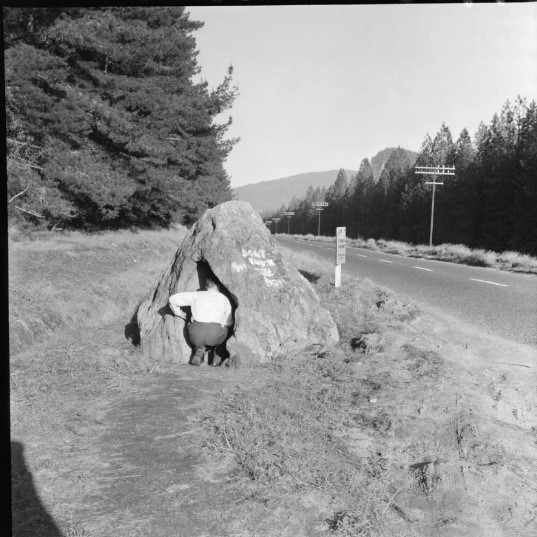


Hatupatu's historic landmark rock on the Taupo Putaruru Highway. Evening post (Newspaper. 1865-2002): Photographic negatives and prints of the Evening Post newspaper. Ref: EP/1958/1863-F. Alexander Turnbull Library, Wellington, New Zealand. /records/23247524

The travels of Kahumatamoemoe and Ihenga

Ko Kahumatamomoe te tama a te rangatira o te waka o Te Arawa, a Tamatekapua.  I ū rāua tahi ko tāna irāmutu, ko Īhenga mā runga i te waka rā ki uta i Maketū.
Nōna e takahi ana i te nuku o te whenua ki tuawhenua, nā Īhenga ngā moana o Te Rotoiti-i-kitea-ai-e-Īhenga me Te Rotorua-nui-a-Kahumatamomoe i tapa i mua i tana wehenga ki te kite i ōna tuākana, i a Taramainuku rātau ko Warenga ko Huarere i noho ai i Te Tai Tokerau.
 
Kahumatamomoe was the son of Tamatekapua, captain of the Arawa waka. He arrived on the waka at Maketū, with his nephew Īhenga.
 
On his journey inland, Kahumatamomoe named Te Rotoiti-i-kitea-ai-e-Īhenga (Lake Rotoiti) and Te Rotorua-nui-a-Kahumatamomoe (Lake Rotorua) before heading off to visit Īhenga’s older brothers, Taramainuku, Warenga and Huarere, who lived in the far north.

To read the full story go to the Great Te Arawa Stories website: www.gtas.nz.


Rāwiri Taonui, 'Ngā waewae tapu – Māori exploration - Te Arawa explorers', Te Ara - the Encyclopedia of New Zealand, http://www.TeAra.govt.nz/en/map/14143/kahumatamomoe-and-ihengas-journeys (accessed 14 March 2023)


Ihenga and the patupaiarehe

I ngā rā o tuawhakarere, ko Te Tūāhu-a-te-Atua i te tihi o Ngongotahā te kāinga o tētehi iwi porehu.  E ai ki te kōrero, he iwi ira atua i mau ai i a rātau te mana atua, ka mutu, i mōhio whānuihia te iwi rā e kīia nei ko te Patupaiarehe.

Long ago the summit of Ngongotahā called Te Tūāhu a te Atua (The Altar of the God) was the home of a mysterious people called the Patupaiarehe. They were thought to be an iwi atua or people of supernatural powers. To some they were known as the ‘fairy people’.

To read the full story go to the Great Te Arawa Stories website: www.gtas.nz.

In the following image of a 1913 survey map the Fairy Spring is clearly marked.


Land  Information New  Zealand (LINZ) and licensed by LINZ for re -use under the  Creative Commons  Attribution 4.0  International licence.


This post was written by Alison


Sources:

Stafford, D. M. (Donald Murray). (1999).  Pakiwaitara: Te Arawa stories of Rotorua. Reed.
Hatupatu and Kurangaituku. (n.d.). Retrieved March 14, 2023, from https://www.gtas.nz
Travels of Kahumatamoemoe and Ihenga (n.d.). Retrieved March 14, 2023 from
https://www.gtas.nz
Ihenga and the patupaiarehe (n.d.). Retrieved 14 March, 2020 from https://www.gtas.nz
New carved house at Whakarewarewa (1906, January 15).  Auckland Star. 
Institute of Cadastral Surveying Inc. (1913) [Survey plan of part of Rotohokahoka D North No.2A Block]. [Map] Retrieved April 19, 2023 from Cadastral Index.


Friday, 6 March 2020

Rainbow and Fairy Springs : a brief history

Rotorua Tourism at it's best.

Fairy Spring = Te Puna a Tuhoe 
The name derives from Tuhoe-potiki, eponymous ancestor of the Tuhoe tribe. Tuhoe was able to spend some time in this district while travelling to Waikato. His residence here was close to this spring which from that time was known by his name. in Pakiwaitara: Te Arawa stories of Rotorua by Don Stafford. c.1999
*Trout were imported into NZ from c.1867, and the 1st trout ova (an American Brook Trout) were released in Rotorua was 1874. https://teara.govt.nz/en/acclimatisation/page-2

*The earliest recorded memories and diaries of intrepid tourists to our fair region have been published in newspapers of the late 1800's and up to 1945. These newspapers are accessible via New Zealand National Library digital website Papers Past.

Here are some excerpts about the Fairy Spring which was made famous by those early tourists :

Auckland Star 8/4/1899, an excerpt from ‘A trip to Rotorua’ by John Millar. 

NZ Times 26 Apr 1899, an excerpt from “NZ’s Wonderland Visited” by J.G.
…”Fairy Spring throws up 5 gallons per day of icy cold water…”

Manawatu Herald 11 Dec 1900, an excerpt  from ‘The wonderland of NZ’ by Chas Austin.
… ‘Fairy Springs 2 ½ miles from Rotorua is a very pretty sight (Guide 6d) and should not be missed”


Photographs by J. Batchelor, printed in "Rotorua: Wonderland of New Zealand"
(publication date not known).

Some famous tourists who visited the Spring were :
  • The Prince of Wales in 1920
  • The American Fleet in 1925
  • The Duke and Duchess of York in 1927
Some other milestones of the Springs :
Owners Bert & Mavis Fort added Aviaries of introduced birds, a Tea House, and baby animals for children to enjoy. Other animals joined the family too, a deer named 'Lulu', a wallaby named 'Joey', goats named 'Punch' and 'Judy' 

There was also a shop where souvenirs could be purchased 'in good taste without being expensive' 


Photograph by Don Cole in "Rainbow Springs-Rotorua New Zealand" published c.1977.

To see a copy of their brochure come in to the Library and see our display on the 2nd floor.


To visit the Te Puna a tuhoe spring today
go along to the Mitai Village on Fairy Springs Road.


Rainbow Springs and Motor Camp 

c.1921 – The piece of land, later to be developed into Rainbow Springs, was owned by Mrs Duffle who kept a few cows. [Peggy Allen ‘Rural community, Rotorua,  1920”]

c.1929 Ted Bruce purchases the property develops the Camping Ground with the Springs as an add-on.  

This photograph was taken at the Springs in 1938 and is the property of Lorna Bartlett
This copy kindly lent by Ray Punter
This photograph was taken at the same pool as above in 1939
Pictured is Hazel Pilcher with a friend.
This copy kindly lent by Ray Punter

The following advertisement appeared in the New Zealand Herald in 1938.


From Library records we know that Mr. J. E. Mills purchased the springs in 1967 and developed the springs part of the business.

And in 1973 – Rainbow Motor Camp & Springs, merges with Fairy Spring.  Mr T. R. Woolliams who bought the lease of Fairy Springs for $60,000, 2 years ago, has decided to sell the Springs so that he can spend more time with his other commitments. In Daily Post. 

New owners for the Springs: Chartwell Trust owned Rainbow and Fairy Springs and Rainbow Farm from 1974-1995

1975 – A new nocturnal Kiwi House opens – Kiwis were fed on beef heart cut in strips to resemble worms; spaghetti; fruit; vegetables and thiamine supplement.  


Here a Rainbow Springs staff member prepares the food
ably assisted by the Kereru on her head.
Photograph by Don Cole in "Rainbow Springs-Rotorua New Zealand" published c.1977

Between 1976 and 1981, Chartwell commissioned and worked with architect Roger Walker for the redevelopment of the Gift Shop and café. The path connecting Rainbow and Fairy Springs was established c.1980 and in 1986, Rainbow Farm opens on opposite side of Fairy Springs Road.

1987 saw the opening of a Tuatara enclosure.

Page one of the Rainbow Springs brochure c.1996 

The springs at that time also had a number of other native and introduced species which could be fed by purchasing the food at the springs shop.
These included Red Deer, Captain Cooker pig, and a Thar.

In the 1990's further development of the springs included a $1.5 million upgrade, a restaurant, an underground viewing room, a new entrance and new attractions at the Rainbow Farm. The Springs was sold to another owner c.1995.  

A few more milestones as found in the Daily Post: 
2003 – Rainbow Farm Show sold the owners of Mt Tarawera 4WD Tours.
2004 – ‘Kiwi Encounter’  developed further.
2007 – Rainbow Springs celebrates 75th Anniversary.
2011 – Log Flume Ride – Big Splash opens.
2018 -  Playscapes and Water Play Areas added.
2018 - Rainbow Springs celebrates 85th Anniversary  
2019 - "The National Kiwi Hatchery Aotearoa has welcomed its 2020th kiwi chick, just in time to celebrate the New Year.

The special kiwi hatched on December 30 at the facility, which is hosted at Rainbow Springs Nature Park in Rotorua, and he or she is part of what is shaping up to be the hatchery's busiest season yet."  In Daily Post online 31st December 2019.
This post written by Alison, with thanks to the Don Stafford Collection, Rainbow Springs Nature Park, Ray Punter and the Daily Post.

Friday, 25 October 2019

October Tourism Attraction News

This blog post highlights tourist attractions that opened in Rotorua during the month of October. There were also other related events mentioned that occurred in the month of October.

Related Events of Note in Rotorua

October 1895
Tolls were in introduced for those visiting Mokoia Island
6 October 1900 
First outbreaks of Waimangu Geyser noted
October 1963
‘Rotorua Māori Arts and Crafts Institute Act’ (New Zealand Māori Arts and Crafts Institute Act 1963) passed by Parliament. This act was to preserve Māori heritage and culture and promote and foster an awareness of and appreciation for it.

Tourist Attractions Rotorua

Rainbow Springs
22 October 1938              Rainbow Springs opens as a tourist resort

Daily Post 22 October 1938

Tourism Leaflet 1969, Rotorua Library
Photo Provided

Located at the foot of Mount Ngongotahā, Rotorua. Early visitors paid a toll of sixpence where they could see the rainbow trout in the clear icy cold pools. One visitor included the Prince of Wales who fed the trout during a 1920 tour. 

23 October 1939              Paradise Valley opens as a tourist resort

Auckland Libraries Heritage Collections AWNS-19060412-4-5

Located 6 miles from the Rotorua Township. The new attraction includes native bush, gardens, pumice paved walks, a large spring and terraced pools. Visitors can enjoy afternoon teas and other refreshments.

11 October 1960              Toot & Whistle Railway begins operating in Kuirau Reserve

Daily Post 12 October 1960

15 October 1986              Rainbow Farm opened

23 October 1986              Paddlewheeler, Lakeland Queen, launched on Lake Rotorua 

Daily Post, 23 October 1986

This Post was written by Ani Sharland with thanks to the Daily Post and Auckland Libraries Heritage Collection.

Saturday, 8 April 2017

Book Review : Rainbow and Fairy Springs by S & D Cole.

Rotorua's two well known Springs

Cole, S., Cole, D. (1985?). Rainbow and Fairy Springs.  Rotorua: Rainbow and Fairy Springs.


A short 24 page publication that includes a brief history and highlights the different areas of the park. It was interesting to note that the park was opened to the public in 1928, but had admitted visitors, possibly as early as 1898. Reading about the trout, kiwi, native birds and native forest brought more of an appreciation for the amount of work that goes into maintenance and care of the enclosures and to furthering public education about the species in the park. It’s a brief and informative read with plenty of images.

Postcard of Rotorua's Fairy Springs from the collection of Colleen Jeffrey.
Photo by Cherie Priest at Rainbow Springs c.1988.

Saturday, 25 March 2017

Fairy Springs and more from Rotorua

Rotorua has many natural springs

Over the years Rotorua's springs have been tourist attractions, water sources for the city and great fishing spots as well.

Click this link to read James Cowan's 1910 article published in a number of newspapers of the day
Otago Witness 27th July 1910

Information with thanks to the Don Stafford File, Tourism 1862-1939 :
Fairy Spring was free to visit and fish, until 1897 when the visitors were charged 6d for the privilege.

The next was Rainbow Springs opened in 1928, where people could put their hands in the water 'tickle the trout' and also to feed the two famous fish 'Elsie' and 'Hori', sadly Elsie died in 1949, no mention is made of Hori's demise.  Rainbow Springs Camping Ground was opened and run by Mr E. Bruce in c1928.

  In 1973 the Rainbow & Fairy Springs merged to become one business and the new owners set about planting trees and upgrading walkways between the two.  Today this is known as Rainbow Springs Nature Park.

Paradise Valley Springs is written as being open to the public in the Rotorua Morning Post 23.10.1939. However as the link below shows, this area was being visited in the early 1900's.

Hamurana Springs was a thriving business as one of the best trout fishing areas of the region as early as 1887, also one could "gaze into an immense hole, which in every 24 hours emits 5,000,000 gallons of cold water" from New Zealand Tablet 11 June 1903, page 5.
A Fishing Lodge was available for keen anglers to stay from c.1923.


Tourist at Hamurana Springs, November 1961 from Kete Rotorua

Click these links to read about these springs from Papers Past :
The Paradise Valley Spring Evening Post 1st October 1904
The Hamurana Springs NZ Herald 10th March 1891
The Rainbow Springs NZ Herald 21st November 1936
The Fairy Springs NZ Herald 7th March 1906

From Kete Rotorua :
The Taniwha Springs Fairy Springs and Taniwha Springs

Taniwha Springs was opened to public prior to 1955 when it was reported that a two-toned trout named 'Harvey' underwent an operation. [what for is not known]